
Tracing My Roots in Częstochowa
by RABBI ARI NOAH ENKIN (Ramat Beit Shemesh, Israel)
Although I grew up in Montreal with four living grandparents (and two great-grandparents – one from each side), I was never given any history about my ancestry. That’s right, I don’t know the names or places of almost anyone I am descended from. The only exception to this was from my maternal grandmother Sophie Handman and her mother (my great-grandmother) Sara (nee Srebernik) Jarost, who imparted me with my Częstochowa heritage and identity.
Some brief family history:
My grandmother Sophie died about six years ago, a few days after becoming a great-great-grandmother to my granddaughter, Ella. She was fully alert and knew that she had become a great-great grandmother. My great-grandmother, Sara, known as “Sally” in Canada, died shortly before my Bar Mitzvah. Sara was born in Krzepice and the family later moved to Częstochowa, where Sophie, my grandmother, was born. Sophie’s parents were, as mentioned Sara Srebrnik and Adolf (Aaron) Jarost. Adolf was from Piotrków. I never met him as he died before I was born.
Sara and Adolf Jarost, believing that Hitler would indeed do what he said he would do, left Częstochowa and immigrated to Montreal before the war began. I was always told that most others in the family (and community) laughed at Sara and Adolf for leaving Poland, arguing with them that it was not possible for Hitler to accomplish what he wanted to do. So, too, Poland would protect its Jews, right?!
With all the above being said, my only heritage and knowledge of where I come from was from the world of Częstochowa. I grew up in Montreal in close proximity to my grandmother and great-grandmother and regularly heard the stories and memories of Częstochowa. Usually, they were only negative memories, such as “it wasn’t just the Germans…”, and the like, although there were some good pre-war memories that I had heard about Jewish life in Częstochowa. As mentioned, I never really heard anything else from anyone about my ancestry. (Note: I very recently discovered about some paternal lineage from Kishinev and will be going there sometime soon for a quick “family roots tour.”)
The Srebrniks of Częstochowa were Gur Chassidim. It seems, though, that somewhere along the line, my great-grandmother Sara broke away from the Chassidic lifestyle. I say this because she married the very secular Adolf Jarost from Piotrków. I’m not sure how that shidduch came about, but I know her parents were not thrilled with the match. Nevertheless, my grandparents, Sophie (nee Jarost) and Maurice Handman, were quite traditional and we had a Shabbat dinner together almost every Friday night, until my parents moved us out of Montreal when I was about twelve years old.
Echoes of what I heard from my grand/great grandmother about Częstochowa had always been on my mind. And, as such, I had often thought about going to Częstochowa over the last twenty years, since moving to Israel and living on “this side” of the world. However, I confess, I have always had negative feelings about Poland and the Poles. While I have no intention of political commentary here, there is no denying that historically, stereotypically, and in much of reality, the Poles didn’t like the Jews, don’t like Jews and won’t like the Jews, as, indeed, “it wasn’t just the Germans…”. As such, every time the idea of visiting Poland came up it never moved me too much though it did remain on the “back burner”.
Eventually I decided that I was going to make the trip to Poland due to a combination of factors that came together concurrently – a cheap ticket, time off from work and my wife’s desire for a “Holocaust tour”.
And so, I reached out to Alon Goldman, World Society Vice-President. (We were already acquainted from our Torah-from-HASAG adventure – make sure you know about it!). Alon encouraged me to go and helped me with all kinds of logistics and pre-trip research. It was me, my wife and my fifteen-year-old son Elimelech.
In addition to the Częstochowa purpose of our trip, we decided to expand the trip to include Kraków and its Jewish history (Thursday-Shabbat), Auschwitz (Sunday) and Częstochowa on Monday. For the first parts of our trip (Kraków/Auschwitz) we were able to join a “J-Roots” tour. J-Roots specialises in Jewish Heritage tours throughout Europe, and they were running a tour of Kraków/Auschwitz on the exact dates we needed! Our guide in Częstochowa was the well-known Hebrew speaking Piotrek Pałgan who, along with Marcin Bocian, gave us an unforgettable experience in Częstochowa.
As per Alon’s advice, we arrived in Częstochowa the night before our tour (15th December 2025) and took a very nice Airbnb apartment at a low price. Piotrek and Marcin picked us up from the train and took us to the apartment. We managed a few hours of sleep and were ready for our tour at 9 A.M.
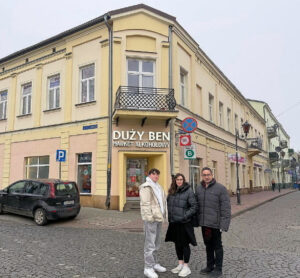 We were taken to all the regular Częstochowa sites, many of which brought back memories from things I heard growing up. The most exciting part of the trip was the visit to the home of my great-great grandfather, Hershel Tzvi Srebernik at ul. Berka Joselewicz 1.
That’s a picture that will descend to future generations, which my children and grandchildren and their children will be able to point to a home and an address in Częstochowa from where they descend.
Also, of note and very moving was the visit to the home and grave of Rabbi Pinchas Menachem Justman. Many descendants of Częstochowa Jews and residents of Częstochowa, today, do not realise that Rabbi Justman continues to be a major Chassidic influence to this day with his work “Siftei Tzaddik.”
He is regularly quoted in all Chassidic circles. People from Israel gave me names (“kvittel”) to pray for at his grave. Sadly, there are not too many other graves to visit due to the destruction and uncertainty as to who is buried where.
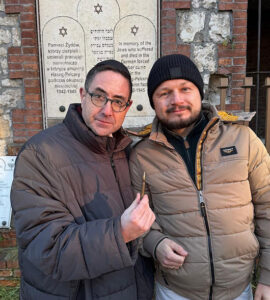 The visit in the HASAG forced labour camp, where my great-grand uncle, Eizel/Edward Srebrnik, (Sara’s brother) and his wife, Esther, were slaves, was also among the more touching sites we saw.
Eizel and his wife survived the war and immigrated to Montreal. I knew them and have memories of them, as well. Marcin showed us an original bullet and whip that was used at HASAG.
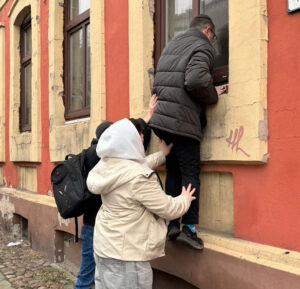 Around the corner from where the New Synagogue once stood (now the site of the Częstochowa Philharmonic, was the building at ul. Garibaldiego 18. which once housed the Częstochowa mikveh. As can be seen from the picture, I tried to get a look inside -but without success.
On a personal note, as a general rule, I wear my kippa wherever I go in the world, unless doing so is “dangerous”. I was told that wearing a kippa in Poland would be “uncomfortable”, but not “dangerous” (which was quite accurate) and so, I wore my kippa everywhere I went. I must note, although, that the looks and stares that I received in Kraków (malls, old town, grocery stores) was not the common “we hate you” stares that I receive in most other places.
Rather, the stares in Kraków were the “we thought you were dead and gone” stares. Really. As readers might know, Kraków was essentially untouched by the Germans. Everything remains as it was: the schools, the synagogues, the mikvahs, the slaughterhouse, etc. – it’s all there! Bring back all the murdered Jews and Jewish Kraków can begin functioning the same day.
Indeed, for this reason, Jewish Kraków has both a beautifully historical but also an eerie atmosphere. I could almost see the great rabbis of old walking the streets. You could almost hear the words of Torah and “aleph-beis” (think “Oyfen Pripetchik”) [Click HERE to view it]) coming from the windows of the schools. The locals realise this and think of Kraków as a museum of Jewish history of sorts – not that there are real Jews anywhere to be found that still live that life!
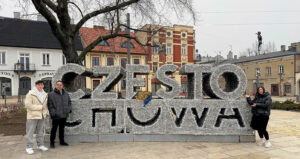
Once again, many thanks to
Alon Goldman, Piotrek Pałgan and Marcin Bocian,
who helped make this an unforgettable experience!
Rabbi Ari Noah Enkin made Aliyah to Israel about twenty years ago from Montreal, Canada, and made Ramat Beit Shemesh his home.
Throughout his childhood, he heard very little about his family history and his family’s roots.
They had emigrated from Częstochowa to Canada prior to World War II.
In December 2025, he fulfilled a long-held dream to visit Częstochowa.
This is how he describes that visit to “his Częstochowa”.
SUBMIT YOUR OWN STORY!
to learn how!