
Jeff Hersch
Another "Birthright" in Poland
by JEFF HERSCH (New Jersey, U.S.A.)
My grandparents grew up in Częstochowa – a small, yet well-known city in southern Poland. It is one of the most important pilgrimage sites for Polish Catholics, being the home of the Black Madonna, in addition to over fifty Catholic churches. Prior to World War II, Jews made up a fifth of the area’s population. But being so close to the border had its consequences: it was one of the first places to quickly fall victim to the German offensive. After enduring the brutal Nazi-occupation for nearly five years, my Grandfather and Grandmother were the only survivors from their respective families in 1945. They vowed never to return to Poland. In November, I decided to visit.
It was cloudy and bright gray all morning. I was lucky enough to be accompanied by my girlfriend, who had met me in Israel after Birthright. We had gone from Tel Aviv to Budapest, and now to Poland. We rode the train for two hours, seeing rural Poland along the way. A Poland that was synonymous with “the old country”, comprised of vast hills, farm animals, and small, colourful houses spread throughout the fields – “The old country”.
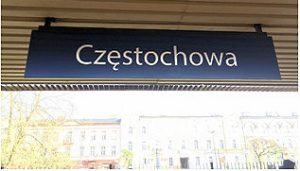 The girl at the front desk of our hostel was taken aback when I asked for a train schedule to Częstochowa. “Aside from religious Polish people, I’ve never heard of foreigners visiting that city,” she proclaimed. I explained to her that I was neither Catholic nor looking for some religious enlightenment, but rather I was on a personal journey to my family’s historical roots. As the half-empty train approached Częstochowa, the blue sky began to peek through the clouds and, before we knew it, the sun was out as we came to a screeching halt.
Prior to leaving New Jersey, my 94-year-old Grandmother gave me the address of her childhood home. The last time she was there was in 1945, after the War, as a young, distraught twenty-something. On a napkin, without hesitation, she drew an impromptu map of her neighbourhood. From the train station, she indicated that her apartment building was only a block away. Katedralna 7 was her address (she even spelled it right). I was in awe as she vividly remembered her neighbourhood from seventy five years before. “There was a market in my building and a bakery across the street”, she described, as she pointed poignantly in the air with her eyes closed. It was incredible to witness. I took her information and confirmed it with a map online. I showed her a street view of the building now in present-day to verify it was still standing. That was enough to make her cry.
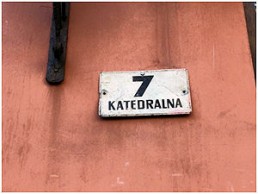
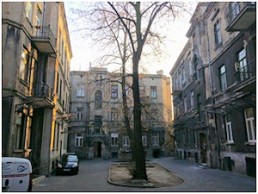
Katedralna – the experience quickly became surreal. I soon found myself in the courtyard of her apartment building. I stood there, mostly in silence, taking it all in, while imagining the neighbourhood bustling with life. Unfortunately, I had no knowledge of which actual apartment my Grandma had lived in, but seeing the building was equally significant.
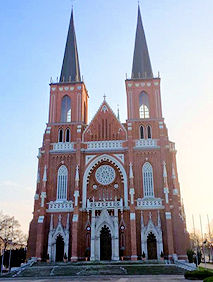 Around the corner was a huge church (pic left), one of the biggest I had ever seen. I immediately recognised the church, not by its immense size, but by its significance in the story of my Grandparents. This was where the Germans had rounded up Jews on September 3, 1939 – “Bloody Monday.” My Grandfather, then 18 years old, was rounded up with his brother and father, and detained in the church. This is the church where Jews were kept for days and routinely shot at with machine guns. I had heard this story, but standing there, trying to imagine the terror endured, was surreal. I can still hear my Grandfather’s voice telling the story, describing his father jumping on top of him and his brother to shield them from the bullets. That was the first of many assaults they encountered.
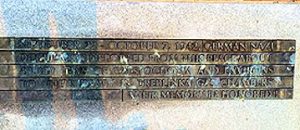 As we continued our walk through the neighbourhood, we came across a large memorial dedicated to the Jews of Częstochowa. The brick monument resembled a ghetto wall and stood in the exact spot where daily round-ups and deportations took place. Accompanying the wall was a plaque which read September 22-October 7, 1942, German Nazi occupants deported from this place about 40,000 Jews of Częstochowa and environs to their death in Treblinka gas chambers. Their memory be honored!
I stood at the memorial and was overcome by an existential force. After a minute of standing there, tears flowed uncontrollably. I thought about my own existence, my life and the experiences I call mine. This was the spot where my then 17-year-old Grandmother was separated from her parents and three brothers, and where she became completely alone, aside from having my Grandfather at her side. (He, himself, was only 18.)
I thought about my entire family’s existence – aunts and uncles and cousins and their children – and the fact that they all stem from my two Grandparents. Had either of them perished, my family would have simply ceased to exist. By something that can only be deemed a miracle, they survived six years of hell, while their friends and families were murdered by the hands of the Nazis and their associates. I thought about all of their relatives who perished and imagined how big my family would be today had they all survived.
But most of all, I realised just how amazing it is to be alive and how grateful I truly am to wake up every day. At that moment, I was extremely proud to be Jewish. I recognise that my existence is a way to prove the efforts of those who sought to destroy human life. based on simple differences, unsuccessful.
Visiting Częstochowa was, in fact, a birthright. It is an experience that will stay with me forever.
SUBMIT YOUR OWN STORY!
to learn how!

Lowi, Noa Yalon
My Częstochowa
by NOA YALON LOWI (Israel)
Background
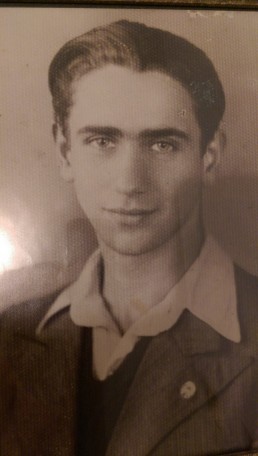
Yosef (Yosek) and Esther (nee Mendelowicz) Fridman both grew up in Częstochowa, in parallel streets, a few minutes walk away.
Yosek was born in 1916 in Częstochowa and lived ul. Garncarska. His father died when he was still quite young (long before World War II). Esther was born in 1917 in Krzepice and, while still a child, her family moved to Częstochowa and lived ul. Targowa.
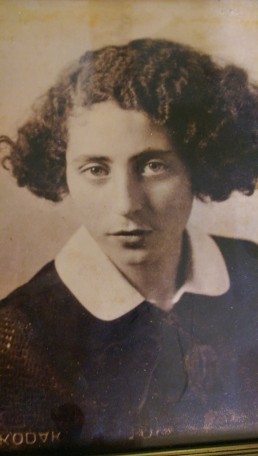
Yosek and Esther both joined the Gordonia movement, and later, after the Hachshara, immigrated separately to Palestine – Yosek in 1938 and Esther in 1939.
Yosek had six brothers. The eldest, Dubcha (David), was invited to the United States. He emigrated, married and remained there until his death at a ripe old age. All other five brothers perished in the Holocaust, together with his mother and the rest of her family – three brothers and two sisters.
Two of Esther’s brothers, Yitzhak and Chaim, immigrated to Palestine in the early 1930’s. Esther’s illegal immigration to Palestine was financed by her brother Chaim and she remained grateful to him all her life. Another brother, David, survived the HASAG forced labor camp in Częstochowa and immigrated to Israel after the War. All her brothers, her parents and her other relatives perished in the Holocaust.
Yosek and Esther attended a training camp in Givat Ada and, shortly after, moved to Ma’aleh Hahamisha, where they originally intended to go. They then moved to Bnei Brak, where they decided to start a family out of a desire to raise children. During World War II, Yosek enlisted in the British army. In 1945, their daughter Nitzana was born, followed by their son Aviram in 1950.
Yosek and Esther were my grandparents (my mother is Nitzana), I am the Third Generation of the Częstochowa family living in Israel. In July 2017, I traveled with my family to Częstochowa.
My Trip to Częstochowa
My writing has been blocked, Ever since the visit in Poland.
Something has been thrust, something is blocked.
Something is choked inside and won’t come out.
What happened there? We knew all along that the majority of the Granny’s and Grandpa’s families had perished. That wasn’t a surprise.
We knew about the Holocaust.
We didn’t that think we’d discover a happy ending, something which history had forgotten to tell us about.
So, why this freeze? We hadn’t visited any of the extermination camps. We hadn’t seen harsh sights – not extremely harsh.
We simply went to visit the city where they had grown up and which we had been told about. But it actually began with a suffocation almost from the very first moment.
With excitement and sadness, we arrived at Częstochowa. As we approached the station and saw the “Częstochowa” signs through the window of the train, The heart raced, pounding, as tears climbed the throat, commencing their way out. We got off the train.
As I walked, trying to trace the sign I saw from the train to get closer and photograph it (as well as allowing my tears to burst out), We were welcomed by wonderful Małgosia and Marek, our warm and fantastic, guides whom we had hired to show us around all the places which we wished to see. They smiled broadly and warmly at us, as they held out their hands to help us down from the train. We found ourselves smothering our tears, swallowing them in order to greet them nicely, introduce ourselves and thank them for waiting for us with such devotion.
This blend of genuine gratitude and fought-back tears arouse caged anger and frustration. I felt, “I wanted a moment to digest and process it all and to meet you marvelous people five minutes later and not precisely now.
And you were so lovely and generous,you aren’t the source of this anger nor the shoulder to cry on. Thank you and it’s not fair. Why couldn’t you have been late a few minutes?
And so here began the journey to the past, to the city and to its civil registry and archives where the keep the birth certificates. Actually, when Auntie Macha was born and when Grandpa was born, Częstochowa was still under Russian rule and the documents were probably in Cyrillic. So doubts arose as to exact spelling and whether the documents will be found. And also, in those days, the registry was not necessarily done on the actual date of birth at all. This was not very common.
A beautiful, elderly woman arrives, waiting her turn. I wonder if she was born here and if she knew Granny or Grandpa. Maybe they were friends, maybe and maybe and maybe. And even if they would have met. Who knows if they would remember each other and, even if they did, who knows if they would recognize each other, even if I had a picture here with me of them from those days. Still, even if they did know each other, what issues would it raise? So they knew each other.
To be honest, she looks younger than my grandparents, even if they were still alive. It turned out that every senior I’ve seen sparked those questions in my mind, time after time. The odds are that they are probably younger than them. But surely, these people were here and experienced and witnessed the Holocaust in one way or another. They are a piece of history walking in front of me and their faces seem stiff and severe. Faces which had seen things that nobody should see nor experience nor should be recorded in the history of mankind.
And even if they were here, which side were they on? The monstrous? The escaping? The compassionate/human/saviors? The indifferent-numb towards this sickly horror? Perhaps they’re former Jews who managed to flee and prefer not to remember they were Jews at their younger years nor to remember some more things, some years in the pages of the history of their own personal life.
We continue to the Jewish cemetery to see the tomb of my great-grandfather, who was lucky enough not to know what future would bring upon his family. A neighborhood of ruined graves hidden within a frightful, dense, ivy jungle. Green, beautiful, creepy and bothering. Some of the graves are broken, some are destroyed, some are perforated by bullets and some of them only display damage brought about by nature.
We are surprised by the three mass graves of the community remnants who were not transported to Treblinka due to some calculation errors. Apparently, Nazis, too, mess up their calculations. So they brought them here, the single one sight which we considered as “holocaust free” and corrected their errors: The Nazis handed them shovels and firstly commanded them to destroy graves. Once the first mission was accomplished, they were commanded to dig an enormous pit and stand lined along its edge.. and…… SURPRISE!!! Here we are now, standing at this same spot!
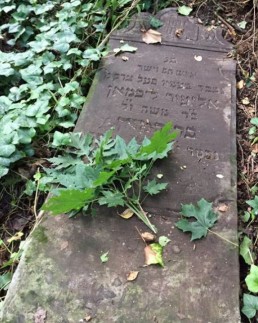
The gravestone of my great-grandfather Eliezer Lipman Friedman in the Jewish cemetery of Częstochowa
This was not simply a cold and sick attitude by those who were following orders to slaughter – similar to slaughtering chickens or cows as if they were objects or products. There was emotion here. There was pure wickedness, cruelty and pleasure from the taste of blood and agony and grief and humiliation. The emotion of the kind which I want so badly to believe, does not exist in the world – even though I know it does, even though it was nothing new, even though variations of this unbelievable horror keep occurring on the planet.
But, suddenly, it was so close, personal, tangible, surprising and heart-rending. And we were standing here, without any clue as to whether our great-grandparents lay here beneath our feet, all my mum’s uncles and aunts or the rest of the family. Were they in one of the two mass graves, or in one we were shown later on that day at a green grass plot at Kawia street? Maybe they’re here. Mum pats the grass in silent tears.
Maybe they are in Treblinka. Maybe they were counted and ended up on the intentional transport lists. Maybe they were at the beautiful New Synagogue which had been burning for a whole week and was guarded by the Nazis to prevent extinguishing the flames. Maybe they randomly pissed off some Nazi soldier on the street and were shot for all to see and to beware. How are we supposed to find out what on earth happened to them? And, what difference does it make??
But for some reason it does matter. The heart desires to know, to address the sorrow and to shepherd the sadness to its rightful place. It is unclear why.
Maybe it is the will to deliver to them the belated message that we care, that they were loved and are mourned, that they were remembered, missed and thought about – even if they didn’t see or feel it, even if all they saw was alienation, numbness and indifference to death, suffering, sorrow and anguish, even if no one stopped when they fell and reached out a hand or at least parted. And also that there is still love in the world, although love is yet to win at all battles and we’ve yet to learn and change sufficiently- There is also love in this psychic world and there probably always will be.
We go to what was the Jewish quarter and reach the streets where my grandparents had lived and grew up. – two parallel streets, the houses, not large within three minutes walking distance apart. It seems most of the houses have not been renovated since that time. In Grandpa’s street, where lived next door to his cousins, there were three houses side-by-side – one of which is now missing. It is the only one on the street missing, as if the earth had swallowed it up. There is no trace of it. Wild vegetation grows between the two houses of the family. We don’t know if the missing house belonged to Grandpa and his family or perhaps it was the existing house, which now houses Polish tenants who look at us with displeasure.
And there are warehouses in the garden of the building, windowless, with wooden doors which turn out to be people’s homes. Who live there today. It is not abandoned and, even though it appears to be a warehouse, it isn’t. My imagination blends with memories of stories going around in my mind. We arrive at my grandmother’s house. Well, not really as Grandma’s house also turns out to be the only one missing in the street. It also was gone. Why? What happened to those two houses in the Jewish streets?
We go to the river where Grandpa, as a child, used to fill a bucket with water to bring to his mother. Her picture hangs in my parents’ living room and flickers in our minds as we walk around here. With excitement, my father recalled what Grandfather told him- that once, in winter, he brought his mother water from the river and, by the time he’d returned with the bucket, walking only a few minutes, the water had completely frozen.
I’d heard that story more than once and when we reached the point where he used to fill up the bucket with water for his mum, we discovered that this is the very place where a memorial now stands commemorating the Jews who were sent to Treblinka, from this site, in six transports of freight trains. It was here that they stopped in the railway tracks passed, precisely here. Perhaps the family had been led here and had never imagined such a journey to their bitter end, as the French and Belgian conscripts who had passed through here and were warned and had not believed and refused to get off the train, despite warnings from the locals as to what awaited them.
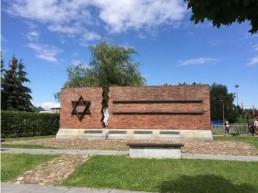
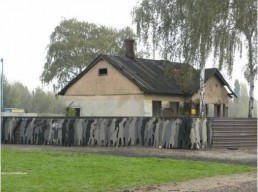
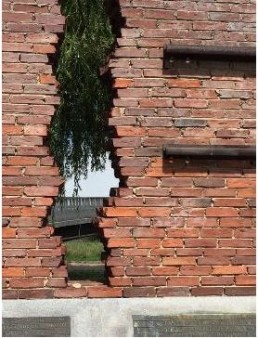
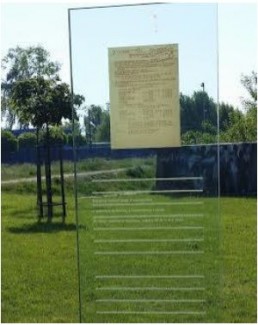
The monument commemorating the Częstochowa Jews who departed from this railway platform on six transports to Treblinka. In the photo above, on the right, the train station building is decorated with a mural created by Częstochowa Fine Arts students. Below right shows the schedule of the six transports which left for Treblinka between 22nd September 1942 and 7th October 1942.
Perhaps some of them were at the Jewish hospital. hospitalised sick and found themselves crushed to death while they were confined to bed. My great-grandmother was already over fifty at the time. Who knows? What are these annoying, abusive questions and why are they not letting go?! Enough! They are gone! All of them! Long time ago! And it did not happen by nature whatsoever.
Touring the two former Jewish market squares showed nothing, just old sidewalks and squares empty of people or a memory of commerce or of life of any kind – just an exercise for the imagination, reinforced by photographs in the Jewish Museum. There was nothing new there either. It was the same in the residential neighbourhoods. It was as if time had frozen, as if they had not moved on and were still horrendous mementos, eternally in dreadful disgrace.
My Dad had been dragging his feet, right from the very beginning actually and grumbled, “Enough of death and depression. Let’s go to the river or to a cafe or a restaurant”. We didn’t understand and we were secretly angry at how could he shut himself with such insensitivity towards us and the guides, who had gone out of their way so to arrive all the sites associated with our grandparents and which we wanted to see. In retrospect, it is clear that it was precisely his sensitivity that led him to beg “enough!”. It had become too painful. The guides were wonderful, sensitive and supportive and hearty, gentle people and giving generously, with all their heart, all the information for which we asked.
Pain and sorrow piled and burned in our hearts and souls.
Thoughts and questions kept pecking my mind:
Why couldn’t we have supported Grandpa. He never talked about this. Why weren’t we there for him? I wished that someone was and had talked to him and processed, with him, all of the inferno and the guilt he experienced.
No one was saved from the Holocaust.
No one who was present, saw it and managed to survive and escape.
Not even those who emigrated before and “only” their whole family stayed behind and perished.
Not even the residents of other countries which the Nazis had not yet reached.
Nor the second generation which grew up without grandparents or uncles, whose parents were traumatised.
No one was saved from the Holocaust.
The entirety of humanity was deeply wounded by this inconceivable event committed by its own hands.
We tour Częstochowa and there is a lot of documentation and monuments and also respect relating to the community which had once lived there and to its history. But there is no trace of life here – just voids and cavities that have been opened in whole streets which have been damaged and have not been renovated all these years, in homes that are missing, in the monuments, in the deserted HASAG’s, in the pictures of the important and beloved figures we didn’t know, nor hear their voices. We were only told about most of them did not even see their pictures.
And there is no sign of life
And nothingness
And nothingness
And empty and burning.
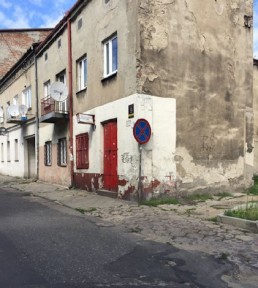
LEFT: Ulica Targowa – Grandma’s house is not the only one missing on this street.
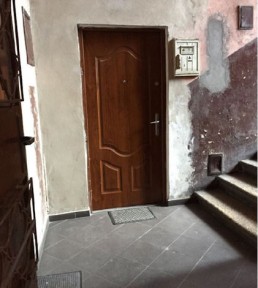
RIGHT: The staircase in the building where Grandpa may have lived in one of the apartments – downstairs, upstairs, who knows? Maybe in the courtyard.
Chen, Gil
Our "Roots" Trip to Częstochowa
by GIL CHEN (Israel)
This was a trip that penetrated deep into the heart and the soul. That was the feeling at the end of a short trip to Poland at the end of October 2012. Neither words, pictures nor videos can transmit the special feeling of a once-in-a-lifetime trip, a return to our roots, to think of the past generations of my family who lived right here, just two minutes walk from our hotel. Right here, just round the corner, how near – how far – and how different!
I will try to share with you those special events that we, myself and our two grown-up children, experienced in two concentrated days in Częstochowa.
It all started with my daughter preparing for a trip to Poland with her school. I realised that this would give me an excellent opportunity to combine this journey with a short “roots” trip, as her journey would end in Katowice, and the city where my father was born was only one and a half hours away from there. This was an opportunity that I was not going to miss. I had to arrange a trip with my grown-up son to collect my daughter at the end of her school journey and to continue on to Częstochowa. This trip had to be well organised, as we only had two days available and our tasks, though not many, were quite involved. We began to prepare. But where to begin?
I gave myself two main objectives – to find the house where my father was born and to find the graves of my relatives in the local Jewish Cemetery. I was curious to learn more about where my ancestors had lived, to try and understand what had happened to them and to feel, primarily, to feel.
Our preparations included several meetings with my father, who told us about his family in Częstochowa and the bitter destiny of most of them. He also showed us a film he had made on his own ‘roots” trip, twenty three years earlier, in which you can see the house where he was born and where his aunt, Gitel Furburg née Silnicki, had lived. The street was named after Giuseppe Garibaldi. No number. Was the house still there? Who lives there today? Was the metal workshop seen in the old film still working? And what happened to the uncle’s butcher shop opposite the house? During weeks before we left, many thoughts constantly ran through my brain.
My father did not know anything about the Jewish cemetery in the town, but put me in touch with key people who provided me with excellent material – Alon Goldman, Chairman of the Association of Częstochowa Jews in Israel and Dina Wiener, who organises the Gidonim project in the Reut High School in Jerusalem. They helped me tremendously and gave me the impression that my journey was important for them as well. I received a lot of material from them and they obtained, for me, many details about the cemetery. I struck it lucky, because the grave of my great-grandfather, Michael Silnicki, who died in 1918, had been ‘discovered’ by the Gidonim students children just the previous year. So there was a good chance that we would find that grave. Moreover, the grave of his brother, Yankel Shilansky, had been documented previously. There was light at the end of the tunnel and our optimism was high. I put all the information into one file. which became our ‘official’ file, so that we would not have to rely on a piece of information, a list, names of graves or photos of gravestones and then realise that we had left them behind in Israel.
A few days before we set out, we were disappointed to hear that a local Pole, the historian Wiesław Paszkowski, who has been researching the cemetery and helping to document and preserve its heritage, would be on vacation whilst we were there and that we would not be able to meet with him. We would therefore have to rely solely on the information which we had received from Dina and Alon. What a shame!
And so here we were, my son and I, already in Warsaw, walking towards the notorious Umschlagplatz, by way of all the markers, till we get there and then on to the Rappaport Memorial. But with all the respect due to this place, and without demeaning it in anyway, my mind is already focussed on the next twelve hours, collecting my daughter from Katowice, arriving in Częstochowa, getting to the cemetery, searching for the graves and for the house.
It’s night. Together with my son and daughter, I have arrived at a small family hotel in Częstochowa. It is situated in an area that was formerly part of the Jewish Ghetto. We are tired out, but nevertheless I connect my computer to the internet and begin to read. A last minute surprise – Alon forwards me a new email just received from the local historian with photographs and additional instructions as to how to locate the graves – but it’s all in Polish. My grateful thanks to the founders of Google, as with the help of their translation programme, we immediately translate it into a somewhat peculiar Hebrew and also save the pictures and the translation onto my daughter’s mobile phone, which is working overtime.
In contrast to the wintry weather and the snow that fell over the previous few days, the weather looks fine in the morning (some more small help “from above” on the way to finding the graves.) The receptionist at the hotel explains to the cab-driver that we wish to get to the Jewish Cemetery, but that he should stop on the way, as we wish to buy some memorial candles. We are nervous, as we know that the next few hours will determine the success or failure of our journey. We really hope that we can find the graves, but who knows in what state we will find the cemetery? Would the material and the explanations that we had previously received be exact enough? Will it be easy to see the divisions between each section? We had been warned that the Nazis had done their best to destroy the cemetery immediately after the invasion of the city, and that the rows inside the cemetery are now not all that straight. Most of the tombstones are buried in the ground, covered in weeds or damaged.
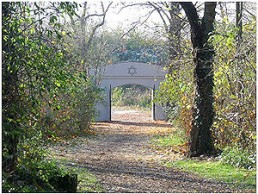
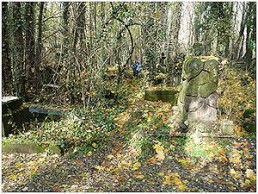
The drive there seems very pastoral, through the narrow forest. Many areas are covered in snow. One more curve and the gate of the cemetery is in front of us. We get out of the taxi and the driver goes on his way. Only the three of us are at the entrance to the Jewish cemetery – us and hundreds of Jewish souls, who had lived in Częstochowa for hundreds of years, lying buried beneath the ground. Right! To work!
We take out our file and read the explanations which we have brought from home and try to match the explanations and theories to the area. We walk along the central path, trying to count the rows of graves. Here is the exposed open area – here are rows of graves on the right and on the left. Here are the trees, all crowded together and here, a bit further along, an area with just odd trees here and there. So where are the graves we’re looking for? We’ve already reached the area of the big mass grave. Only two weeks ago, there was a group here who left wreaths and they are still there, lying in front of the graves. I have a feeling that we should go back a bit. We have passed “our” graves. The bend in the main path is some fifty metres back and, it seems to me that the graves, that what we are looking for should be just before the bend. The actual layout of a place always looks different from the way you imagined it and it is not easy to know where you are, in an unfamiliar place. The historian could really have helped us now and just the week that we’re here, he had decided to take his vacation!
We take out my daughter’s mobile phone and read again what we had received only the night before. “Look for the grave of Jakob Hyelborn on the left and count ten graves along that row.” We look at the picture of Jacob’s grave that we have which, luckily, is unusual and within a few minutes – success! We have found his grave, the first hint that we are on the right track. My son leads the way between the headstones and the graves, along what must once have been a straight line of graves, and we try to count ten plots. Do we count the one which is damaged and lying on its side? Are there one or two other graves under the snow and leaves? Should we take out of the file of the list of graves prepared by the Gidonim and progress according to their list.
My son advances according his understanding and feeling. Count to ten. Surrounding us are a number of graves and headstones. Everything is covered with snow. “Perhaps the grave is to your left”, says my daughter, remembering the photo we had received yesterday evening, showing the gravestone not standing straight. My son clears away the snow and the leaves and reads out the name “Silnicki”. Unbelievable! We have found the grave of the uncle of my paternal grandmother! Amazing! We clean the stone, but cannot find the broken off top part, where his first name would have been written. It is impossible to say how the stone broke and where the grave lies exactly. We light a memorial candle, document it all and find it very moving, above all, very moving.
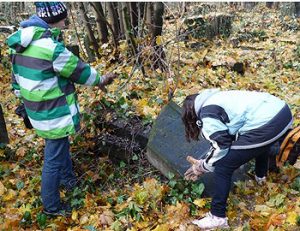 We continue in the same way to look for the other grave. It must be quite near, on the other side of the central path. You don’t change a winning team and our duties remain the same. My son leads and counts the graves. My daughter consults her mobile phone, where we have all the explanations and the photo of the “next hint”. Here is the grave where we have to turn and count thirteen more. We try to progress without treading on the other tombstones and graves. Once again, we clean away the snow and the leaves and….. bingo!! We have found the other grave! I can’t help myself. I don’t forget for a moment that my father is in Israel, and, at this very moment, is certainly waiting anxiously at home for news from us. “Abba, good morning. At this moment, we are standing by the grave of your grandfather, after whom you are named.” I am not normally an emotional person but now I am very moved by it all and there are tears in my eyes. I am sure that, on the other side of the phone line, my father is very moved as well and there, a long way away in Israel, tears are being shed.
Here, as well, the tombstone does not appear to be in line with the grave itself, which we cannot positively identify. We light a memorial candle, say Kaddish and take photos of the gravestones from every possible angle. For the benefit of the generations to come, we film the cemetery and how we found the graves.
We leave the cemetery and wait for the taxi. Interim report: 100% success! We found the graves and were very moved by it all. It is sad to see the destruction wrought by the Nazis; sad to see the mass grave in the cemetery and to try and imagine what happened here during the Holocaust. On the other hand, it was exciting to see the fantastic and very special work the Gidonim youth did here – finding graves and tombstones, and then documenting them. I really must thank Alon and Dina as soon as I get back to Israel. In the evening, back at the hotel,I send photos to my father and also update Alon.
A new day dawns. My children are still sleeping. But I cannot wait and I leave the hotel early in the morning, on a wet and wintry day, to search for the house where my father’s family lived. The street is really very near, about 20 meters from the hotel, but where exactly is the house? I walk excitedly down the street and here, a few meters past the corner, is the house – 18 Garibaldi Street (ed: ul.Garibaldiego 18). I couldn’t miss it! Apart from some outside plastering on the first floor, nothing has changed since the photographs I have, taken some twenty years ago. It all looks exactly the same, including the house opposite. The house is deserted, with broken window panes, and is not inhabited at the moment. Shame! I thought I would meet the people living there and that they would invite me in so that I could feel and breathe the house inside. But there is a big sign on the house, a sign that moves me very much:
Here will be built a Jewish Heritage site, which will include a Jewish Cultural Museum, a youth hostel for participants in the March of The Living, a kosher restaurant, a high school for learning Yiddish and Hebrew as well as a gallery and music hall.
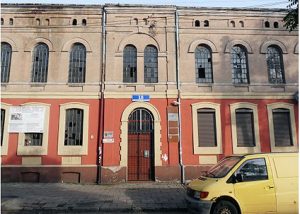
– my grandmother’s family house
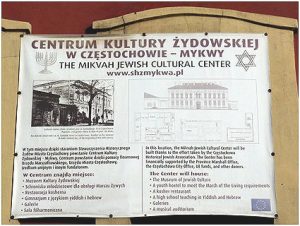
(Webmaster’s note: This sign was put up by someone who had purchased this property several years ago and who hoped to profit from the city’s Jewish past and heritage. The proposed project, not supported by either the Częstochowa City Council nor by the World Society, did not go ahead. Since then, we have seen the creation of the Jewish Museum of Częstochowa – a project supported by both the City Council and the World Society.)
I return to the hotel, wake up my children and tell them about my discovery. I push them to dress and get organised and we go out, again straight to the house. It amazes me that my children and I slept so close to this house where my father was born. Right on this sidewalk, outside this hotel, my grandparents almost certainly pushed my father in his pram. Who would have thought that, just one year later, the Nazis would invade the town? Who would have thought that, more than seventy years later, the grandchildren of that baby would be walking here on these streets?
My children photograph and film everything, climbing up in order to peek through the windows into the deserted and quiet building. The gate to the side entrance is locked. I speak to some young boys who live nearby and who understand English. I show them pictures my father took here, some twenty years ago, and try to find out what happened to the butcher’s shop opposite, which used to belong to my father’s uncle. Apparently, twenty years ago, it turned into an electrical shop. The metal workshop in the house had moved to another place further up the street, but today is a holiday and everything is closed. I show the boys more photos and an old film. They show a great deal of interest in it all. They are amazed that I have documented all this and surely do not comprehend what we are doing, standing next to a dilapidated, deserted house on a cold wet winter morning, and why we came here all the way from Israel. But, to me and my children, the reason is quite clear. This was a once-in-a-lifetime trip for us and, with two successes, it was worth all the preparation and the effort. I feel that we have closed the circle.
In the time left to us, we tour the town, taking in all the places that were connected with its Jewish past and their destiny. In every place, the feeling was “Here my great-grandfather went to synagogue”, “Here, surely, Grandma went for a walk with my dad when he was a baby”, but also “Here my family waited to be collected to be taken to Treblinka” and “Here was the border of the ghetto, beyond which my family could not go”
The journey back to Israel was long and tiring. We longed to be back in our own warm home, to tell everyone about our experiences, to show our photos and films, and to hug my father and to tell him how much I love him.
My Częstochowa
My Częstochowa
Write Your Own Story
Write Your Own Story
Since the fall of communism in Poland in 1989, hundreds of Częstochowa survivors and their descendants have visited the city, either at any one of the World Society’s Reunions or travelling independently. Each visitor had his/her own motivation for making the trip and each trip, in turn, left a very specific impact on the visitor.
For anyone who wishes to share with the rest of us, their experience and any aftermath, we have now set aside a section of our website to enable them to do so. In fact, we positively encourage you to add your contribution!.
- Each contribution should be a maximum of 3,000 words (in WORD or plain text format)
and MUST be accompanied by at least 2 or up to 8 photographs (a page of plain text
without a pic or two does not look good at all)..
- Contributions can be submitted either in English or Polish. Don’t worry if you think
that your English isn’t good enough. We will edit it to fix any spelling and grammar errors,
and will make it read well stylistically. If you submit your contribution in Polish, then your
Webmaster will quite willingly translate it into English.
All contributions
should be
emailed to
the Webmaster
at
aragorn@axiomcs.com.au