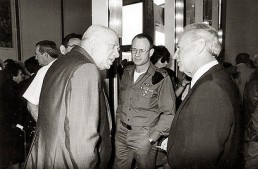
Leon Silberstein z"l
Leon Silberstein z"l
- Nothing Short of a Hero
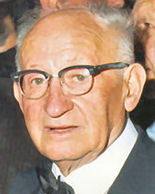 While the Holocaust took the lives of over six million Jews, it also obliterated the dreams and innocence of the survivors left behind. For over sixty years, one survivor, Leon Silberstein believed his tormented past should remain a secret. Today, he wants to speak about the unimaginable events he observed and participated in to clear his conscience and validate his past. This is a tribute to a man, who displayed remarkable courage in the face of adversity and went beyond normal means to ensure the safety of those he loved.
The chronology of Mr. Silberstein’s experiences throughout the Holocaust is of less consequence than the recurring themes that still plague him. It appears that Mr.Silberstein still questions his own survival. “I shouldn’t have lived,” he mutters often. Despite his feelings of disbelief, he is still aware that he made conscious choices to shape his past. These choices are the root of remorse for him.
Behind the frail and soft-spoken man we see today, Mr. Silberstein was extremely talented and brave as a young man. Mr. Silberstein was born on October 28 in 1905 in the Polish city of Piotrków. He was born into a family of eleven children. His mother died when he was thirteen years old. In 1926, at the age of nineteen, he went to Palestine against his father’s wishes. In Palestine, he worked on a farm and declared himself a Zionist. Leon returned three years later to his family in Poland. He sought to return to Palestine, but was drafted into the Polish army.
As a soldier in the Polish army, Mr.Silberstein was stationed in the Polish city, Częstochowa, located southwest of Warsaw. The city was a wealthy industrial centre where Jews worked in many industries, including banking, trading, and crafts. While in Częstochowa, he married a woman named Rose and became a skilled mechanic. With his wife, he opened a three-storey factory that manufactured bicycle parts. Leon had patented many parts himself. While Leon was the mastermind behind the engineering aspect of the factory, his wife took an active role in the financial aspect of the business. His wife went as far as bribing a government official to require that all bicycles must have night lights. As the only bicycle factory able to manufacture such lights, the Silbersteins were able to capatalise on this law and become incredibly successful. Together, Leon and Rose had created the most modern factory in Częstochowa. Sadly, their money and influence could not save them from the wrath of Hitler’s regime.
The city of Częstochowa was invaded by the Germans on 3rd September 1939 and, the following day, more than 300 Jews were slaughtered. Subsequently, all Jewish property was confiscated and 1,000 young Jews were deported to labor camps in August of 1940.
On April 9 1941, a ghetto was created in Częstochowa and was sealed off on August 23. Twenty thousand Jews, from all over were packed into the ghetto. Eventually, the ghetto held more than 48,000 Jews. The ghetto consisted of a large part of the city that included many of the poorer Jewish areas of Częstochowa and few of the wealthier ones. Almost a third of the population had been pushed into an eighth of the city. Three to five families could be moved into two-bedroom apartments. The situation was bedlam. Fortunately, Mr. Silberstein was not limited to the confines of the ghetto.
When the war began, the Germans recognized Mr. Silberstein’s ability as a mechanic and untrained engineer. Although he was Jewish. the Germans had respect for his talent. The Germans dubbed him the “universal tradesman”. It was not long before the Germans had Leon opening safes that held important documents. Mr.Silberstein possessed the incredible ability to visualise solutions to difficult problems even if he was not trained in that particular field. His incredible craftsmanship enabled him to resist living in the ghetto and not carry a blue and white star that identified him as a Jew. This was indeed, a rarity.
Mr.Silberstein’s talent was employed elsewhere. The Germans wanted Mr. Silberstein to build a restaurant for German soldiers in an abandoned building. Before working on the project, he demanded to speak with the commanding officer of the restaurant. Everyone thought he was insane not to just take orders, but Leon thought it was important to understand his client’s taste, therefore making it impossible for the Germans to have qualms with his work. He asked the officer about his childhood and the region from which he was from. Leon deduced that the chief would be indubitably pleased if the restaurant reflected his home town. Besides this, Leon designed an incredible pulley system, where the dirty dishes and food could come up and down from the kitchen in the basement. As well, he sought to make the most cost-effective seating by using as little wood as possible to design tables and chairs.
Mr.Silberstein’s ability as an engineer proved successful and was thus put to work on several projects for the Germans. Hitler’s birthday was approaching and Leon was commissioned to prepare a stage for the band to play on. He was faced with the problem of creating the illusion of a larger space. He did this by using two different colours for the curtains; the lighter would be in front of the darker creating the illusion of depth. His plan was successful. During the project, however, he faced anti-Semitism from a Pole who complained to the Germans that a Jew should not undertake such a project. Leon told the Germans that if the Pole did not stop harassing him he would abandon the project. The Germans sent the Pole away. It was obvious that the Germans could not help but respect such a clever man as Leon.
While Leon’s talent as an engineer was praised, so was his talent for relating to others. Mr.Silberstein was in charge of heading up a group of talented artisans each day, who were highly specialised in various fields. He would pick up twelve to fifteen men and women and take them to work. Work involved clearing furniture from Jewish homes and decorating new German residences. Workers constructed new furniture and buildings. Many served as electricians as well. While he assisted Germans, he was neither servile to the Nazis nor abusive to Jews. For instance, his German officer, Werner once told Mr. Silberstein to whip the Jews that he commanded. He refused and rather picked up a shovel and joined them.
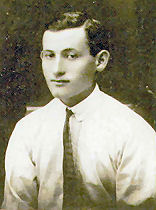 Mr.Silberstein wore two faces as he would like to call it. Not only did he work for the Germans, he worked for the Jewish underground, which was considered at the time to be unthinkable, as the Jews became increasingly few in number and strength. Many of the artisans which Leon commanded were also members of the underground. Oftentimes, they could cover up work they were completing for the Jewish underground, as work they had to do for the Germans. As well, they could get access to German equipment that they could not otherwise use.
One of the recurring stories that haunts Mr.Silberstein is that of his nephew, Jerzyk, who like him, was involved with the Jewish Underground. The Jewish Underground gave orders to Leon to kill a German pilot. It was necessary to obtain the pilot’s clothes in order for the Underground to steal a German plane. Leon asked for volunteers to kill the pilot. The boy who offered was his nephew, Jerzyk, a young scholar, not older than nineteen. Jerzyk was anxious to kill a German to compensate for the death of his father, who was hung at Treblinka. The plan was for Jerzyk to kill a German pilot in a nearby park where they met prostitutes. That night, the pilot arrived on schedule around nine o’clock and was seduced by a Jewish woman disguised as a prostitute. Jerzyk came up behind the pilot seated on a park bench and strangled him with a rope. from behind. Jerzyk fled to the forest with six other boys involved with the Underground.
Leon was well aware that the Germans were spying on his operations. It was necessary for him to relocate the boys. He found a deserted warehouse where he hid the boys and Jerzyk. A few days later, a woman and her two sons came from Warsaw to find some money. Leon recognised that they were Jews and told them not to look for money and to stay in the deserted furniture warehouse in the meantime. One of the small boys decided to look for money anyway. He was found and captured by a Pole, who delivered him to the Gestapo, the German police. It is apparent that Leon was near the scene of the arrest and the little boy called out that he knew Leon and where others were hidden. Leon adamantly denied knowing the boy and having the key to the furniture warehouse. While Leon was not taken for investigation, the warehouse was discovered. All of the boys, including Jerzyk, were forced to confess to the murder of the German pilot. They were all killed. The Germans were in such disbelief that a Jew could kill a German, ten other Polish people were forced to die for the crime.
The story of Jerzyk is of great significance and still troubles Mr. Silberstein to this day. Jerzyk’s choice to kill the officer was in essence an opportunity to commit suicide. Both Mr.Silberstein and Jerzyk knew that the punishment of death was inevitable. While Mr.Silberstein has never wished that he was killed, he feels responsible for giving the command and not protecting a family member. Today, a monument in honour of Jerzyk stands today at Beersheva University in Israel.
There were other times that Mr.Silberstein’s life was spared. Once, Leon knew a German officer, who was in love with a Jewish girl. The officer had Leon take the girl out of the ghetto and bring her to him. Leon warned the girl of the danger of the situation, but she was convinced that their mutual love would protect them. This however was not the case. The Gestapo found out and the officer killed the Jewish girl. Despite the cruelty of the officer’s actions, he felt gratitude towards Leon for delivering the girl. A few days later there was a selection for Jews to be killed in the middle of town. This officer grabbed Leon and told him to take his wife out of the selection. They were both saved.
Additionally, his life was spared due to the profound trust and appreciation Leon established with others. Once the Germans wanted to buy coffee, which was only sold on the black market. The Germans asked Leon to carry out the order of purchasing the coffee. Leon was caught carrying the large bag of coffee by the Polish police. He was arrested and taken in for investigation. It was known however at police headquarters that Leon would never confess. He would remain loyal, even if he worked for the Germans. After being imprisoned for a day, a Polish Major confronted Leon. Rather than kill Leon, the Major told him that he needed a Jew, who was as clandestine and loyal as himself. He made Leon work for him.
A few months later, Leon and members of the Eldestenrat (Council of Jewish Elders appointed by the Germans to handle internal Jewish affairs) in the city were given the opportunity to exchange all of their money and goods to go to Palestine. Leon prepared false identification for himself and his wife in order for them to be transported safely. The day on which they were supposed to leave, a German officer made Leon work and complete various projects. Leon was concerned that he would miss the chance to leave, but he was forced to finish. When he was done, he went to pick up his wife to leave for Palestine, but he saw in the centre of town a bunch of opened suitcases with old clothes coming out. Everyone who had signed up to leave for Palestine had been slaughtered. It is still unclear if the German officer intentionally saved Leon and his wife that day by making him stay later. These are questions that Mr. Silberstein can never answer.
In May 1942, there were orders to kill Mr. Silberstein. A German officer named Lasinski told Leon that he had received an order from a high official to kill him. Lasinski told Leon that if he could find another person with the last name, Silberstein he would pretend that he killed Leon. Leon knew another Jew, Igenia Buca, who commanded a squad of Jews for the Germans. Ingenia Buca had a boy under his command with the last name Silberstein. Leon paid Igenia Buca to tell Lasinski that he had killed the boy with the last name, Silberstein. In the meantime, Leon was not safe despite the deal he made with Lasinski and Ingenia Buca.
Leon went to Werner with the news that Lasinski had to kill him. Verner wanted to save him and thus allowed Leon to stay in his apartment for the night. Leon was able to go home to his wife the next morning, who had not seen him since the morning before. Lasinski came to Leon’s house and told him that the ordeal was over. As payment, Leon made his wife give Lasinski linens. It was her job to sew linens from the cloth of Jewish families that was confiscated by Germans. Once again, Mr. Silberstein was in the position where his life had been spared.
Mr.Silberstein was able to conquer the pitfalls of being a yes-man to Nazis, by always defending his family, and using his power to save other Jews. One of the most apparent cases where Leon displayed unthinkable courage was in the perpetual defense of his nephew Sigmund, the younger brother of Jerzyk. The first time, he saved Sigmund’s life occurred when the ghetto was liquidated in May 1942.
When the ghetto was liquidated, Jewish social, cultural, and political activists were seized and killed. Thirty-nine thousand Jews were deported to the concentration camp, Treblinka in packed freight cars. Children and the elderly were often automatically killed and only two thousand Jews managed to escape or hide in the city.
Sigmund, who was only eleven at the time, was called to be deported along with his mother and Leon’s sister. Sigmund’s father and brother were considered able-bodied and thus allowed to remain in the city. The day on which Sigmund and the others were to be deported out of the bus depot in the centre of town, Leon’s sister spotted Leon working. A brave young woman, Leon’s sister walked into the area where Leon was working and demanded that the Ukrainian guards allow her to speak with him. Although the guards were furious, Leon spotted her and quickly pulled her in along with Sigmund and his mother. He took them to a hiding place where other workers were hiding their relatives. Remarkably, the three had been saved from the awful fate that lay only a couple hundred yards away.
Subsequently, Leon kept Sigmund and the others in a hiding place and eventually transported them into the small ghetto, which was the northeastern part of the ghetto. That section held some five thousand able-bodied Jews. Sigmund worked with the rest of the Jews Leon headed up and fell under the care of Leon and his wife when the rest of his family was eventually exterminated in concentration and labor camps.
Mr.Silberstein saved the lives of many others that bore no relation to him, other than the fact that they were Jewish. Once a girl asked Leon to bring her cousin to a boat that would take him to Germany. The boy had false papers to leave safely, but needed the assistance of Leon, who could travel the city freely. Leon thus manned a horse wagon and hid the girl and her cousin under hay in the back. They were able to get outside the ghetto unscathed, but once they arrived at the boat, the dock master demanded more money from the boy. Leon sensed that trouble would ensue and told the two that he would return them to the ghetto. While on the way from the boat, Leon was stopped by an official, who noticed the girl’s coat on top of the hay in the wagon. The official asked why Leon had such a nice coat and demanded that Leon abandon the wagon and let him drive it to the ghetto. Leon was able to convince the official that the coat meant nothing. Before returning to the ghetto, Leon deposited the coat and the boy’s false papers in a burnt-down house, and return the two safely. Once again, Mr. Silberstein had risked his reputation and life for others.
Mr.Silberstein’s ability to reason with the Germans assisted him in saving the lives of others. Mr.Silberstein once saved an entire family from the Nazis. The Rosencweig family had managed to hide underground in a shelter they built. The family consisted of many children and elderly persons, who would surely be deported to death camps or killed on the spot. Eventually they were found out and taken for investigation. Leon had known the family for years and was able to get the family pardoned by providing a service to a German official. The service was protecting the official from being killed by the Jewish Underground.
Mr.Silberstein’s name was well-regarded by this point and could work alone to save other Jews. At one point another selection occurred, but this time in the small ghetto, to weed out the “undesired”. The Jewish intelligentsia, which included professionals and academics were supposedly to be exchanged for German prisoners to go to Palestine. Leon however learned that no such exchange would take place and that the intelligentsia would in fact be taken to a cemetery and shot to death. Leon also learned that some friends that worked under his command were going to take part in the exchange. Leon rushed to the deportation site and picked out the people, thus saving their lives.
In the midst of this heroism, Mr.Silberstein had to participate in many dramatic and heart-wrenching experiences. The most significant was his participation in the murder of a Jewish traitor. For years, Mr.Silberstein has been hesitant to discuss this portion of his experiences. While he does not regret his actions, he has feared that such an act may be misinterpreted and reflect poor judgement on his part. As well, it is unthinkable that such betrayal occurred between Jews and Mr.Silberstein worries that others may doubt the validity of his story.
The Jewish ghetto eventually was separated into male and female living arrangements. Where the boys lived, a tunnel existed that went from the basement out of the ghetto. In the basement German clothes and arms were collected. One day, someone told the Germans that the tunnel and basement existed. As punishment, forty-three young boys were killed. The Jewish Underground asked Leon to find out who told the Germans the secret of the tunnel. Due to Leon’s connections with the German officials, he simply asked who revealed the secret. The Germans told him a man with the last name Rosenberg had tipped them off.
Rosenberg was a Jewish policeman, who patrolled the ghetto at night with other policeman. Leon knew that a traitor could leave the ghetto with no problem and he noticed that Rosenberg did. Leon was not fully convinced that Rosenberg was a traitor and did not want to act rashly. Leon asked a Sergeant in the Jewish Underground to let him know when Rosenberg was leaving the ghetto. When Rosenberg left the ghetto, Leon followed him to the train station with the Sergeant. Leon worked out an arrangement with the Sergeant where if he raised his hand that indicated Rosenberg was guilty.
Mr.Silberstein approached Rosenberg and saw in his attaché case the blue and white cap that Jewish policeman wore. Leon grabbed the hat and said to him, “You are a Jewish policeman who is not allowed to be alone. I have to take you to the ghetto to be shot.” At that moment, a German official overheard, kicked Leon in the spine and told him that the policeman was not his concern. When the German official came to the defense of Rosenberg, Leon knew that indeed he was a traitor. Leon then lifted his hand to the Sergeant.
Mr.Silberstein returned to the ghetto and calculated a plan with the Jewish Underground to murder Rosenberg. The Underground staged a fight and Rosenberg being a policeman came to break it up. The Underground grabbed him and took him to the basement where they forced him to reveal his crime. Afterwards, they gave him water with cyanide. He was buried in the basement.
Despite the severity of this story, Mr.Silberstein always made prudent judgements. This was the case in the closing of Mr. Silberstein’s life in the Holocaust.
Before the concentration camps and cities under German control were liberated in 1945 by the Russians, tens of thousands of people were killed in the final days that led up to the liberation. People often died on “death marches” that took place from camp to camp or in final acts of brutality by the Germans, who tried to cover evidence by exterminating remaining prisoners. The night before Częstochowa was liberated on June 16 1945, Leon got word that the Russians were coming. Leon knew that there would be danger. Already Sigmund was about to be deported to a labor camp with others. Luckily, Leon was able to take him out of the selection. That evening, Leon gathered a group of about a hundred and twenty people. On his authority and self-assurance, he led the group out of the camp around nine o’clock at night in freezing temperatures. They walked 3-4 hours in the direction of a Jewish cemetery in Auschliter where there was an air field. The circumstances were dangerous as German tanks were to the left and right of them. Eventually, people started complaining about the freezing temperatures. Leon turned the group around and by that point the Russians had begun liberating the city. Leon’s group were among the first Jews to be liberated. When the Russian army liberated Częstochowa, there were as few as 5,000 Jews in the area versus the 28,500 Jews that occupied the city when World War II began.
Mr.Silberstein’s nephew, Sigmund Rolat, compares this story to Moses leading the Jews of Egypt. This is a fine analogy to the courage and leadership Mr.Silberstein displayed when he took his own people and remaining family out of danger, risking his life. Despite Mr.Silberstein’s amazing fortitude, he could not save the life of his son. A tragedy which still looms large in his mind.
Mr.Silberstein and his wife had a son named Zygmuś prior to the war. Zygmuś was an incredible child. Advanced for his age, he read at the age of four. Like his dashing father, he was very handsome. Throughout the war, the Silbersteins were able to protect the child through Leon’s influence. However, towards the end of the war, they believed that they and their child would be killed eventually. Therefore, they left Zygmuś in the hands of a Polish doctor and his wife. When Leon would visit, he gave the doctor money and jewels in exchange for caring for Zygmuś.
After Częstochowa was liberated, Leon went to the doctor’s house to find Zygmuś but he was not there. For 6-8 weeks, Leon looked for him each day. With each passing day, he gave up hope. Finally, they found out that Zygmuś had been killed. A few days prior to liberation, Leon believed that he and his wife would surely be killed. He therefore gave the Polish doctor huge sums of money and jewellery including a three-karat diamond. Leon figured that if he and his wife died, their son would be better protected and at least live with a wealthy family. The doctor, however, in awaiting their death and believing he had received the majority of their wealth, did not feel he could expect any more money in the future. He had drowned Zygmuś in a river.
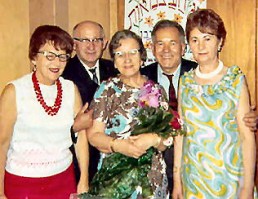
Leon and Rose
(2nd and 3rd from the left),
with friends, celebrating
Rose’s service as
Secretary of the
Częstochowa Relief Society
of New York- Brooklyn Branch
Mr.Silberstein continues to question his action to surrender the majority of his wealth too quickly in the end. He believes that this final donation prompted the doctor to kill Zygmus. Although Leon and his wife survived the war a large portion of their spirit had been destroyed, leaving permanent sadness in their heart and home.
It is terribly sad that Mr. Silberstein’s soul will never be at rest. He can never forget the pain and terror that he witnessed or go back on fateful decisions he made in the past. This is a great tragedy as Mr.Silberstein has exhibited more strength, courage, sensitivity, and love than anyone could in their lifetime. While he has lived his life serving others, he is too distraught and too modest to realize how he has acted as a great giver to humanity.
Leon Silberstein is nothing short of a hero.
Submitted by:
Leon’s son
Alan Silberstein.
It was written in 1995
by
Jill Tanen
a young college student.
Sadly, Leon passed away
a year later, just short
of his 92nd birthday.
This piece was published in
Ben Giladis
The Voice of Piotrków.

Edja Rosenzweig Darrow z"l
Edja Rosenzweig Darrow z"l
- a Story of Survival
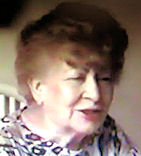 Edja Rosenzweig Darrow was born in Częstochowa on 21st October 1921 into a warm and loving, family of eight children. Her very orthodox father was a skilled but very poor shoemaker and could not spare the money even for her to have a Zionist-club uniform. What he liked to do was sing. He was a cantor and a “Klezmer …. with a three-piece orchestra.”. At the age of 12, Edja left school to earn money for the family.
While growing up, she experienced the disbelief and pain from various antisemitic acts, such as pogroms around Passover. One spring evening, her brother’s throat was slit while he walked along the Aleja. He recovered, but the scar led to his early demise later when the Nazi’s selected him as “unfit”.
Her life changed after the Nazis invaded Poland and entered Częstochowa. On that “Bloody Monday”, 4th September 1939, her father was among the men mortally wounded and he died a few days later.
In April 1941, she moved in with her sister, when all Jews were forced to live iniside the ghetto (created on 9th April 1941). She became a food smuggler and regularly made her way through the sewers, forests and fields to eventually visit villages (15 kms away). She returned after dark, through a secure manhole, with fifty kilos of food. “Your grandmother was my best customer,” she told me. She became reacquainted with my family, grandparents (Avraham and Hendel) and my aunts and uncles whom she had met earlier in much happier times.
During the ghetto liquidation, she was waiting with the many on the separation line, when a friendly woman advised her on how to feign illness from typhus and escape. She was German and had been expelled by the Nazis for being married to a Jew working in Germany. She explained to the “go-left/go-right” Nazi inspector that Edja was sick, probably from “typhus” and he waved her away to use the “regular” latrine at the train station. She forcibly opened the window and escaped to the recently-harvested fields. “I actually didn’t have where to hide. … I was praying to G-d that the Poles people dodn’t find me… the Poles would cut my throat“.
Hunger forced her to steal from farmers’ barns. Afraid of being caught, she turned to the shops in Częstochowa. Finally, the increasingly cold nights made her seek a way to work inside the new HASAG ammunitions factory. However, she was caught and asked to step aside and at the end of an uncertain day “they [German interrogators] asked us to swear that we will work and help the Germans win the war, and after the war you will be free ”.
Her sister and child were less fortunate and were deported to the Treblinka extermination camp. She met her brother-in-law and a few other friends. He protected her from the brutalities of the factory and the nearby barracks. He was first to tell here that the Russian army was approaching, a fact soon verified (when almost all the German officers, in civilian clothes, drove off to the west).
However she and a group of teenagers from HASAG had already been selected to be transported via a Nazi-guarded, regular train
… not to a hotel or for pleasure, (but to be) liquidated in the crematorium. And I was already planning. This is the chance I have to escape … All of my friends said: ‘Listen! You cannot escape. They will shoot us.'” Taking the lead, she said, “Stay with me, we are going to escape. … We’ll knock the window out.” ‘They will shoot!’ I said,’Wouldn’t you rather be killed by a bullet than give them the satisfaction, after so many years of concentration camp and beating, to let them burn you? No way! I have to live to tell the world what went down here!’ We lived like in the Dark Ages. …
So, when the train slowed at a place she recognised, she gave the command to jump, and all twelve jumped into a snowy forest amidst a hail of gun fire .
I was the last one – to make sure they (made it) out – they were so afraid! I was shot in the left leg … the bullet didn’t go in, it just hit the muscle and ripped out a piece of the flesh.
From under the snow they scavenged
.. good mushrooms. They weren’t the poison ones. And blueberries. We’ll survive on this. Making our way, we found a dead high-ranking German officer, so I took his boots and put them on. Then I took off his coat, with the big insignias and soon I hear ‘Halt! Halt! Halt!’ from a Russian soldier with a machine gun. He was accompanied by (a partisan) … and I could see that he must be a Jew, an intelligent. … He says to him in Russian, and I understood, ‘Don’t shoot. She’s not a German!’ I opened up the coat and they saw the striped dress with a number. The partisan kindly took off all the insignias, ripped off all the buttons from that coat and said, ‘You almost got killed because of the uniform. We thought you were German.” I told him as much as I could. He said, ‘We liberated the camp.’
The coat was dragging on the ground. Who cares? I was warm, for once, but also very feverish, tired and I’m sick – I did not know your aunt Ethel (who died in the camp) had typhus. And I was sitting on her bunk in HASAG during our last week and I picked up the typhus germ. … And then I collapsed from exhaustion and fever. They took me to a hospital (formerly a high school) and I was there until I recuperated. … The doctors and nurses said ‘Boy, you have some strong will. Nobody could believe that you would survive the night when we found you. You wanted to live more than anything in this world.’
She returned to Częstochowa, as did others from around Poland and Russia. She visited the former ghetto streets but none of her family had survived. She was alone again.
One day in April 1945, she was approached by disguised Israeli Haganah men “chayalim” and told where and when to gather to leave war-torn eastern Europe. The group made its way on foot, hitchhiking and by railroad, “..even as the ripped tracks were still being fixed”. To disguise the group, they told Russian and national interrogators in different cities various things.
In Hungary, we were Czechs, etc. and the guides were helping these people to find their former homes ….
I traveled from April until September, through Czechoslovakia, Hungary, Romania, and Austria, on the way to Italy. The Chayalim who were helping us took me to a weekly party and the group was approached by a Jewish-American GI who was curious.
When she heard that he was from New York City, she immediately switched subjects to making contact with her father’s friend from Poland, Shaul Weissgut, who had become an edical doctor in there. Shaul was to be the intermediary to find her relatives in the United States. Someone passing by had a camera and she offered to pay him to take a photo. He did it for nothing, had it processed and she wrote on the reverse side her father’s name and his address. She then turned to the GI and said ,”… (my relatives) will help me. I want to go to America.”
The soldier looks at me and he says, “I have no choice. I’m weakening and I’ll give in to you. Where would they find you? Where do they write to you, if I do find the family?” Then the GI inquired, “If I am successful, how will I contact you to follow up?”
After some discussion, the GI said he knew Rabbi Nissin of Padua (head of the Rabbinical Society in Northern Italy) and she should contact him.
After being smuggled across the border and moved around northern Italy, she made her way to Padua.
I walked into the Rabbi’s office. And I don’t know what’s wrong with me, but I have a face everybody recognises me. And he says, ‘Where were you? I’m looking for you all over! I have here a telegram from your family, and a letter!’ I opened up the telegram. I still have it. You want to see it? and it said, ‘We know you are alive. Grandma Anna and Aunt Rose.’ (Note: Anna Rosenzweig & Rose Comita). Then I got the letter, ‘What happened to you? We wrote. We sent you a telegram and we didn’t hear from you.’ … I sent my name and everything to the family (in the US). Aunt Rose got affidavits for me to immigrate. And I was called to the American Consul in Genoa. Boy! The whole camp thought I’m leaving the camp in a week, a month. It took me over five years to be eligible to come here.
In Italy, I wasted away my young life. They wouldn’t let me in because I am under the Polish quota and the quota was observed. When my number comes up, then I would be able to go to America. The family wrote many letters. I have all the copies of the letters to the American Consul, to make it possible for me to immigrate. I am all alone. I am an orphan. The family got killed and I went to prison camp. I am a lonely soul. We here in America, we can support her, so she wouldn’t be a burden to the United States government. Nothing helped. President Truman gave the first law he made to let in 200,000 refugees, Jewish refugees into this country. So I was with this group to come, the first group. The first group came in December, and I came in in February, 1945. While I was in Italy, I learned the Italian language and I went to school to learn to be a nurse. Wherever it will happen, HIAS told us, learn the language. If you have no ability to learn a language, at least learn a trade. No matter where you go, you can always make a living, if you know to do something with your hands.
Submitted by:
Norman J.Zabuski
Edja was finally reunited with family, married an American Jew, and adopted a boy. She died three months after my interview with her and was buried in New Jersey. I am sorry that I did not become her friend and confidante until so many years later.
Back in 2002, it was virtually impossible to check the accuracy of 81-year old Edja’s facts. Now in 2012, I have checked many facts and note that her recollecdtions was amazingly accurate!
I had often given rides to Edja and her husband to bi-annual dinners at our cousin, Sylvia Taubenfeld’s, home in Teaneck, NJ. During one of our ride-conversations, she told me that she knew my Zabusky grandparents and uncles and aunts in Częstochowa prior to World War II and in the ghetto until it was liquidated. Here, at last, was the opportunity to learn something of my roots. I asked her and she agreed to be interviewed and recorded on the topic of my grandparents. When I began the interview, she surprisingly opened up with an overview of her youthful life in Częstochowa and her remarkable and miraculous story of survival during and after the War.
Words on a page do not convey the tenacious personality of this unique individual. Her accented voice was unfaltering, clear and rarely drifted from delivering the answer, often with humorous quips. The Edja before 1950 (her arrival in the USA) was thin, short, not well-educated, unworldly (no telephone, internet, or TV). I visited Edja in hospital in October 2002 – three months after the interview. She died a few days later.
Pola Horowicz Sigiel z"l
Pola Horowicz Sigiel z"l
- for her friends
A POEM FOR MY BELOVED CZESTOCHOWA
Everything on earth passes slowly
Memory of good fortune and of what brings pain
All that passes thus, seeks a purpose.
One thing remains – memory.
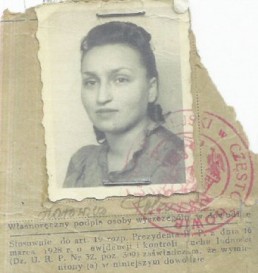
who perished at the hands of the Nazis (1942): Stefka Landau For my best friend, Jerzy Rozenblat, who died the death of a hero fighting the Nazis,
|
[Webmaster: Sadly, Pola passed away on 11th March 2009.]
Pola was born on 12th April 1923 in Częstochowa, Poland, the only child of Aaron and Lea Horowicz.
When the War came, her family was sent to Treblinka. Pola survived by working in the HASAG-Pelcery camp as a slave laborer. She was liberated on 17th January 1945. After liberation, she married David Sigiel in Częstochowa on 2nd September 1945. They then traveled to Germany and chose life, giving birth to her daughter Lea. Only 5 months later, the small family arrived in America, to start new lives.
Over the years, Pola was a surrogate mother to many of the second generation. With her enthusiasm, positive attitude, intelligence, sense of humor, interest and above all, her exceptional memory for people and places, Pola was the source of information and insight, providing a bridge to the past and for the children of survivors, to each other.
Pola is survived by her daughter Lea, and her husband Alan and her grandchildren Alexander, Andrea, and Geoffrey and his wife Jennifer. Her beloved husband, David Sigiel passed away in 2007.
Submitted by:
her daughter
Lea Sigiel-Wolinetz
– Executive Director,
World Society of Częstochowa Jews
& Their Descendants
Joseph (Yuzek) Shein z"l
Joseph (Yuzek) Shein z"l
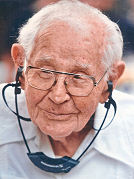 Yusek, who was born in Częstochowa on April 21st 1915, came to Palestine in 1935 as a member of a Polish teen sports team in order to compete in the Maccabean games.
As he proudly said, “only the flag returned to Poland”, because every member of that team remained to build the Jewish state. Yusek proudly worked as a laborer, building the port of Tel Aviv.
In 1936, he met Basha Shpivak, the love of his life. She wanted to return to her native Lublin to see her family and try to persuade them to leave in the summer of 1939. Yusek financed that trip, hopeful that she would return and become his wife. Despite a harrowing journey, she returned to Palestine and they married in a simple ceremony in 1940.
Like many of his generation, Yusek attended the university at night after working a full day, completing a course of studies to become a teacher. He served in the Hagana and, later, in the IDF, achieving the rank of lieutenant in the Corps of Engineers.
When the state was declared in 1948, Yusek danced in the streets of Tel Aviv with his 5 year old son, Michael, on his shoulders. A month later, during a cease-fire, Nurit was born.
Yusek’s talents as a master teacher, his generosity of spirit, his passion for Zion, his facility with languages and his appetite for adventure made him a perfect candidate for service to the young state as a Shaliach. In the 1960’s and 1970’s, he served in London, Copenhagen, and Mexico City as a representative of the government, encouraging and enabling aliyah.
Following his retirement from teaching, he served as Chair of the Teachers’ Union and was a leader in creating a Hagana memorial and by chairing the Chevrah Kadisha for Hagana members.
His beloved Basha died in 1995. Yusek lived on his own into his nineties, reading voraciously and travelling abroad. A lifelong athlete and sportsman, Yusek will be remembered and sorely missed by all of us who were blessed to have encountered and shared his passion for life and for people, his keen mind and his unquenchable curiosity about the world and great ideas.
Yusek is survived by his brother, Yitzhak Shein of Holon, his son and daughter-in-law, Michael and Shira Shein, by his daughter Nurit and her partner, Rabbi Sue Levi Elwell, and by five grandchildren and their families – Tal and her husband Nir, Ayelet and her husband Nir, Daniel, and Sue’s children Hana and her husband Niko, and Mira.
May his memory be a blessing.
Written by:
his daughter
Nurit Shein
and
Submitted by:
Alon Goldman
Alvin "Buddy" Rothstein z"l
Alvin "Buddy" Rothstein z"l
 How They Got There
He’d been shot down before, so that was nothing new. He’d flown 16 previous missions. And a few weeks before he’d ditched his plane in the North Sea – that was in February of 1945, when hypothermia sets in in 20 minutes.
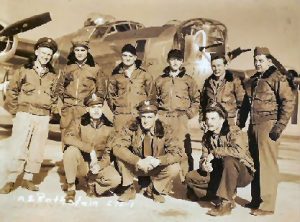
Now it was March 17th of the same year. And, finding themselves just barely recovering from a flak attack, not knowing whether they were upside down or right side up, Lieutenant Alvin “Buddy” Rothstein of Mountaintop, Pennsylvania, and his co-pilot, Lt. John Bogardus, were lost.
“We were bombing out of England, March 17th, to Ruhland. We ran into flak, anti-aircraft, the electricity was knocked out. Right wheel fuel tank didn’t seal. The hydraulics were out, fear of a spark, lost 10-15 thousand feet. We were in the scud-cloud cover-can’t see wingtips-needle [the magnetic compass], ball and airspeed still working. My co-pilot and I- he was great- got the plane recovered out of a spin, but didn’t know where we were.”
Over their Ruhland [southeast of Dresden] target at 28,000 feet above cloud cover called “scud,” they’d released their bombs when the right wing of the plane was hit by German anti-aircraft fire. The plane had gone into a flat spin and dropped into the scud-visibility zero.
In fact they’d been attacked by German anti-aircraft guns. Four planes were shot down and Buddy and his crew were the only survivors, a nine-man crew. “We were doing strategic bombing over Ruhland-the target might have been an oil field, factories, ball-bearing factories, anything to impede the war effort there.”
It was morning, “very early. We flew from England on ten-twelve hour missions-these were listed on a board at the briefing. A bomb group had four squadrons each with 12-13 planes. Each plane had an 8 or 9-man crew, 25 bomb groups in a formation, like a bomber stream, one bomb group after another over the target.
“The British flew at night. Going over you’d see the British planes coming back, single ships, one at a time. They didn’t want to fly formations at night. Even one at a time it was dangerous. Often a green crew came in and both planes went down. Collision. No survivors. We flew three, four days in a row. One day’s flying was a mission 10 or 12 hours long.”
So here they were, hearing “kerchunk, kerchunk,” as flak tore through the plane. The intercom was dead. They were still airborne, barely under control but had no idea of crew casualties or damage to other planes. As it turned out, a white-hot piece of flak had torn a hole in Sgt. George Livers’ shoe and sock, scorching his ankle. Sgt. Joe Brown’s wrist was scorched by a piece of shrapnel tearing through a metal table his hands were resting on. And damage to the plane was severe.
Lt. Rothstein realized they could never make it back across Germany, the Western Front, and the North Sea, to England. The navigator had brought maps of Germany, France, Holland, not of Poland or Czechoslovakia. Their only hope, risky at best, was to keep the plane airborne, fly east, and hope to reach the Russian-occupied zone. They flew on three engines, with only the magnetic compass working – no hydraulics, none of the cockpit indicator lights or gauges functioning; the gyro-compass had tumbled. Nonetheless they got ready to make an emergency landing, with no real idea where they might be coming down.
“At least we were in the East, behind the Russian lines. I started letting the plane down slowly. We could have run into a mountain. We couldn’t see. But through a break in the cloud we saw a city in the distance. It was early afternoon, 1:30-2:00 pm.
“We see a small grassy field, small planes. What is it? What is the city? Russian reconnaissance and fighter planes were parked. We were trying to get our landing gear down, cranking by hand, hoping to get close to the edge of the field.”
They didn’t know how much fuel they had left, only that when it was gone the plane would go down under little or no control. The precarious landing meant that while Rothstein circled the field, Lt. Bogardus worked the wobble pump next to his seat to provide emergency hydraulic pressure to the landing gear and the braking system. Engineer and Top Gunner Leroy Genoway was lowered by his wrists to make sure the landing gear was locked, and only then could Rothstein touch down as close to the end of the field as possible and immediately drop the tail so that tail drag would act as a brake.
As soon as he thought it safe, Lt. Rothstein stood on the brake pedals-they worked. The B-17 rolled along the short grass field, rapidly approaching a stone wall. Rothstein released the right brake pedal, the plane spun left and stopped.
Parked on the field were several small aircraft which Rothstein hoped were Soviet planes, and they were – small Soviet artillery spotters and some fighter planes, one of whose pilots the crew would soon meet.
Welcome to the Soviet Zone
“The war had taken a turn,” recalled Rothstein. The Russians and Americans, so recently Allies, were mutually suspicious. The Russians had reportedly encountered Germans in American planes, wearing American uniforms, so they were understandably wary. “The Russians,” Rothstein said, “were taking no prisoners, killing American flying crews. We decided to leave our pistols on the plane.” Warily the men descended from their airplane.
“We’re immediately surrounded-bayonets, burp guns [machine guns].” Rothstein, the Captain, salutes the man in charge and offers the only Russian he knows: ‘Ya vas drug, ya Amerikans. Speak English?’
“‘Nyet.’
“‘Parlez Francais?’
“‘Non Nyet.’
“I didn’t want to speak German and get shot, so I took a long shot. ‘Redden Sie Yiddish?’
“The guy says, ‘Du bist a Yid?’
“Turned out he was Officer in Charge, a Jew from Odessa, Boris Petrovich Kasig, a Russian fighter pilot,. saved our lives.”
Rothstein and his crew learned later, mostly by means of sign language, that the unit surrounding his plane had been ordered to shoot all captured prisoners. Because of Lt. Kasig the order was quashed.
Częstochowa
They were in fact in the Russian zone, and the now-nearby city they’d seen in the distance as they approached was Częstochowa, Poland, two months after its liberation from the Germans.
“The little village where the Russian military hosted us was 16 kilometers from Częstochowa.”
Since Lieutenant Kasig still didn’t know when the fliers would be repatriated, they had much time on their hands.
“One day we all walked into the city. There seemed to be very little war damage. The mayor offered us a house to live in, but since we were military we felt we should stay where we were. We attracted a huge crowd, people shouting ‘I have sister Chicago, ‘I have cousin Detroit.’
“The Poles hated the Russians. Their history hasn’t been that great. The Ghetto. The Warsaw Uprising. The word was out the Americans were here to liberate them from the Russians (all nine of us).
“Paul Dempsey, the nose gunner, had Bugs Bunny painted on the back of his jacket. Wherever we went, ‘Micky Mouse! Micky Mouse!” The friendly crowd grew larger and larger, soon pressing in closer and closer, backing them finally into a wall. “Mounted police had to disperse them to allow us to walk through the city.
“They took us on a tour.A priest gave us a special tour of the monastery (Jasna Góra, shrine of the Black Madonna), and told us about the abuse they suffered during the German occupation. They plundered, they stole all the valuable art objects that were hidden away. It was heartbreaking what the Germans and Russians had done.” The airfield where Rothstein and his crew had landed had previously been used by the Luftwaffe. The Russians had removed the mines they’d left when they retreated from the area.
The Americans were escorted to the Hotel Europa, the front doors were locked from the inside, and the police dispersed the crowd outside again. Into the lobby came a Soviet officer. Lt. Rothstein saluted him and was in return saluted. Understanding that they were Americans, the Russian took Rothstein by the arm and escorted him and his crew into the dining room where they joined other Russians.
The Soviet officer ordered meals for everyone-“with the usual, black bread, garlic pickles, potatoes and vodka.” Before the Americans had quite finished, the Russians took their leave. French leave, as it turned out-the bill had not been paid. Rothstein tried as best he could to explain to the hotel manager that none of the Americans had money of any kind. He seemed to understand, and the American crew walked back to their village.
“Another day, a few officers took a young chick and me into the city in a long touring car. They treated me to a Russian style haircut, but were dismayed when I refused to allow them to replace my chipped front tooth and the one next to it with two shiny stainless steel ones. Apparently that was the plan.
“Częstochowa looked like a busy place. I remember seeing a glass sign on a door: ‘Goldberg.’ I got excited. Knocked. Man answered. ‘Goldberg?’ I asked. Shook his head. Like everything else, they took over.”
Rothstein found no Jewish presence in Częstochowa on that visit, although there were probably around 5,000 Jewish survivors there at that time. It was two months after the liberation by the Russians, and a year before the Kielce pogrom.
In the meantime, back in England, Buddy and his crew had been declared Missing In Action.
“For a few weeks we lived with the Russians. They moved a family out of a small house outside the village, and we used the public bath.” The house had a hand-pump. Nuns from the local Roman Catholic church did their laundry, only asking that they be allowed to keep half the soap.
Boris Petrovitch Kasig checked on them everyday.
“‘What do you hear?’ Buddy would ask him.
“‘Alvin, Moscva gavrit nyet – Moscow says nothing.'”
Passover in Ukraine
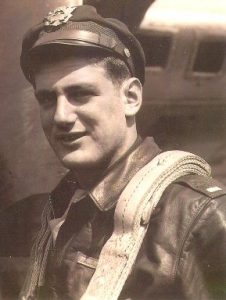 After more than a week as guests of the Russians, the Americans learned that an American Air Force DC-3 had landed at the airfield. They boarded and were told by the pilot that they would take off as soon as a truck from a nearby village, carrying a downed American B-24 crew, arrived.
Rothstein had heard about “Special Operation,” under the command of Otto Skorzeny, through which English-speaking German troops were causing havoc behind the Western Front. Fearing a similar trick, and a one-way flight to Siberia, Rothstein questioned the pilot to make sure he was really American and not an English-speaking Soviet officer. He was indeed an American, from Buffalo, and the plane took off for the joint Soviet-American base at Poltava in Ukraine.
As they were landing, Rothstein looked down at the airfield and thought it looked like a junkyard, it was littered with so many aircraft. “They were not in great shape.” Many wrecked aircraft strewed the ground, Soviet and American, bombers and fighter planes.
“Poltava was a creative idea, but brief. The Allies used it for shuttle bombing. Drop their bombs in Germany, go to Poltava, fuel up and get bombs and bomb the Germans on their way back to England.
“So once the Germans followed them. Stukas. German dive bombers leveled the place.”
But while Buddy and his crew were there, they had a far happier experience. At Poltava there was a meteorological centre run by a Major Marvin Rubin, and two small hospitals manned by American doctors, where Rothstein was treated for deteriorating skin conditions and Sgt. Joe Brown was treated for a near-fatal case of dysentery.
“There was a rough rustic building where they handed out clothes.” The officer in charge was Sgt. Rubinoff. When he gave clothes to Lieutenant Rothstein, he asked him, “‘Do you have any other Jewish boys? We have eight here.” Two Jewish guys named Abramowitz and Brown were part of Rothstein’s crew, so there were three more Americans.
“Seder in two days,” Rubinoff said.
Some of the American Jewish men at the base had managed to requisition the necessary food. The Russian cook at the base was Jewish and was more than glad to prepare the dinner.
And Seder there was, in a bombed-out building, with matzos flown in, “pesadiche cake, catered by a Jewish guy in the Russian army. He’d been a caterer in civilian life. He’d bring in the food and leave. He was not allowed by the Soviets to stay.” Nor were other Jewish guards at the base.
Buddy paused for a moment. “I can’t go to or have a Passover Seder,” he said, “without knowing what freedom really is. So if I seem happy, I am.”
From Poltava, Rothstein and his crew were flown back to England via Teheran, Cairo, Athens, Naples, and Marseilles.
Going Home
When the American crew returned to England, “they thought we were dead. They took us to the Dead Man’s Room where they had all your stuff to send back to the ‘next of kin'”
He mused about the aftermath of the war. “There are four of us left from the crew. We were never able to find Joe Brown, the radio operator. He was from Scranton. His wife and my wife were in Brownies and Girl Scouts together. Almost a fluke he ended up on my crew.
“I came back to the States after Germany surrendered, and I was classified to go over to the Pacific to learn to fly B-29’s. Beulah and I decided to get married. We were on our honeymoon when Japan surrendered.” Abramowitz survived the war. He was from New York, but it’s not known where he lives now.
“There was a point system. You enlisted for the duration plus six months. But with enough points you could get out. I was not a military man. I enlisted because there was a war, a bad war.”
How He Got His Start
In fact Rothstein had first worked in a defense plant, Westinghouse, making turbines for the Navy, and was draft exempt.
As the war got hotter, he wanted to go. “I was twenty, twenty-one years old. I had two six-month deferments, then three six-month deferments. After seeing too many war movies, a lot of anti-semitism, I decided that’s really where I belong, and I was fortunate enough to get started and complete pilot training.”
After arduous training he graduated a Second Lieutenant from the Blytheville, Arkansas, airfield. He wanted to go into the Air Force, the Army Air Corps as it then was, and had crammed for the entrance exams and passed.
“I had total confidence that no one was getting better training than I. I was always a very physical guy, played varsity football in high school. And when I got into combat I didn’t choke.
I marvel at what they did. The pressure was great. More intense in each place until the four-engine bomber, bigger than a house. I thought, I’ll never ever learn how to fly this. That was good later on.”
It was in Jackson, Tennessee, early on in in primary flying school and ground school classes that he learned something that saved their lives over Częstochowa.
“I flew a Stearman, two-passenger ‘yellow peril’ for the Navy, very maneuverable, learned how to recover in a spin. Very uncomfortable. You’re looking down but it’s sky. You look up and it’s earth. They teach you how to recover the plane, recover your senses and do it in a hurry.
“In combat you’re in all kinds of different circumstances-plane shot out under you, engines out.”
At the end of Mission 17, Buddy and his crew were able to land near Częstochowa precisely because of their extensive training in coming out of spins, flying through soup. But that was to be his last mission.
A Full Life and a Happy Coincidence
“I ended up being the father of four children, six grandchildren, married 59 years, a builder, developer, in real estate. A full, rich, happy life.”
One of the happy coincidences of that life was an unexpected reconnection with Boris Petrovitch Kasig, the Odessa Jew who saved their lives in the Soviet zone in Poland in 1945.
“My son Dan practiced law for nine years in Moscow, is fluent in five languages. There was a charismatic leader of the Jewish community, Colonel Goichberg.
“Dan said to him, ‘What can I do to help?’
“‘We’d love to teach people Hebrew,’ Goichberg said, ‘but the Russians won’t let us, but maybe you could.’
I Am Boris Petrovitch
“Dan set up two classes, beginning and advanced. Then he told the man he ‘wanted to set up something for my father. He wanted to find Boris Petrovitch Kasig.
‘The guy said, ‘That’s not a Jewish name. There can’t be such a person.’ There was a small Jewish newspaper there, four, five pages. In a few weeks they put in a story about him with Dan’s law office phone number. It had big circulation, that paper.
“A few weeks later a phone call came: ‘I am Boris Petrovitch, and I’ll remember that day as long as I live.’ Boris told Dan to ask his dad about ‘the secret word – laughing-hyena.'”
It turned out “laughing-hyena” was the punch line to a joke.
“Dan flew to Yalta, 1,200 miles away. He met Boris, such a wonderful guy, sweet, warm guy. He wanted to get a job after the war. The answer was, No – you’re a Jew. He married a Russian woman whose father was an Orthodox priest, killed by the Russians. They had two kids. He spent two days with them. Later on they kept in touch. Got stuff weekly to them with the firm’s courier.”
Buddy and Beulah Rothstein had made plans to meet Boris and his family, but “Boris died before we got to see him.”
More Recently
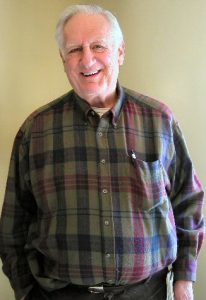 Far from living in the past, however, Buddy has long been active in Rotary International, making friends the Rothsteins are still in touch with.
“We spent three weeks in Tamil India and three weeks in Sri Lanka, and we’re in touch with people there. We were team leaders for a Rotary program. Studied the factories and farms, learned how they did business, exchanged ideas, and they sent a team over here for six weeks. In a letter dated December 9th, 2004, one of the daughters writes, ‘Dear Auntie Beulah and Uncle Buddy'” with news that though the Rothsteins had stayed with them in Gall Seaport, they now live in Colombo and so escaped the horrors of the tsunami. The daughter is now a medical doctor, her brother an engineer studying aeronautical engineering in Wichita.
“I contacted the district governor in Rotary there,” Buddy said, “to see he has help and so on. The parents were in Colombo when the tsunami hit.”
On September 25, 1997, The Honorable Paul E. Kanjorski delivered a tribute to Buddy Rothstein in the House of Representatives, in connection with Rothstein’s being honoured by the Ethics Institute of Northeastern Pennsylvania. He mentions Rothstein’s military service and his realty company, Rothstein Inc. and Rothstein Construction, Inc., his presidency of Wilkes-Barre Rotary, his service to B’nai B’rith in housing for the elderly, as well as service to the Economic Development Council of Northeastern Pennsylvania.
A second-generation American, Buddy Rothstein, born in Wilkes-Barre, Pennsylvania, indeed had a full rich life.
[Webmaster: Sadly, Buddy passed away, at the age on 90, on 25th January 2012 in Wilkes-Barre.]
Submitted by:
Iris Rosencwajg
Iris, who teaches English at Houston Community College’s central campus, is a second generation survivor and serves on the Holocaust Museum Houston’s Academic Committee. Her father emigrated from Częstochowa to Houston.
She based this article on interviews with Buddy Rothstein and on various newspaper articles,
including one written by Ray Saul, in the Hazelton, Pennsylvania “Standard-Speaker”.
Bolesława Proskurowska z"l
Bolesława Proskurowska z"l
We stand before the remains of Bolesława, of blessed memory. In a moment, her body will have eternal rest in mother-earth. Deep in mourning, in silence and profound thought, we bow our heads not only over remains of the deceased. We also bow our heads over the remains of the generation which experienced the greatest tragedy of the Jewish people in modern history.
The life of Bolesława was a living tableau of the tragedy of our people – a people who, for over three centuries, has lived in Częstochowa. Amongst our small group of Częstochowa Jews, Bolesława was a determined bridge between the present day and a world which has irrevocably departed.
With pride, Bolesława always stressed her own origins. She was, at the same time, a patriot of her city from which, despite various opportunities, she did not wish to leave.
Always with a sense of humour, she vividly remembered her own childhood and her younger years. For hours on end, she would speak with the young people of the Słowacki Lyceum (from which she, herself, was a graduate), about pre-War Częstochowa, about the tragedy of the ghetto and of the Holocaust. She concerned herself, to the last of her days, with present-day problems. She was a cultured lady often delving into the wealth of Polish and world literature and poetry. She loved being surrounded by a world of people, animals and nature.
With her sunny disposition, with a joke, she could bring to life every meeting, supporting each of us in moments of difficulty. She taught us patience, to draw joy from the smallest things in life, to be proud and to remain in the traditions of our own people. In the blessed Bolesława, we lose a friend and “a member of the family” who was so necessary in our lives, such as we would miss one of our cousins, aunts or uncles.
On behalf of myself and in the name of the whole of our circle of members of the Częstochowa branch of the TSKŻ, we bid farewell to the blessed Bolesława Proskurowska.
The Eulogy at
the funeral of
Bolesława Proskurowska z”l
held on
11th August 2006
delivered by
Halina Wasilewicz z”l
– former Chairperson,
Częstochowa Branch
Social and Cultural
Association of Jews
Translated into
English by
Andrew Rajcher
Esther (Ada) Frajman Ofir z"l
Esther (Ada) Frajman Ofir z"l
- Częstochowa Holocaust Survivor
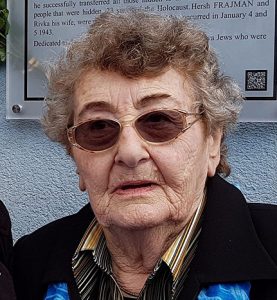 On 22nd September 2016, during our World Society’s Fifth Reunion, a memorial plaque was unveiled at Stary Rynek 24 (Old Market Square) commemorating the site where, seventy four years earlier, Esther’s family and other Jews went into hiding.
That was the day when the Nazis began the liquidation of the “Small Ghetto”. The cramped, damp basement of that building became the hiding place for twenty seven Jews, the survival of whom became a mission for Esther’s father.
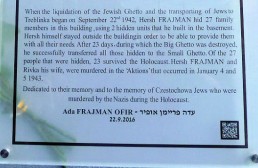
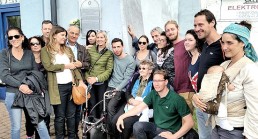
The memorial plaque (above) was unveiled by Esther in the presence of her children, grandchildren and great-grandchildren, and was covered by the local media. The plaque honours the memory of her parents and the Jews of Częstochowa who perished in the Holocaust.
Thankfully, for posterity, Esther wrote her memoirs entitled, in English, “Thus Began My New Life”, the PDF’s of which are available to read online, by clicking on one of the three links below
Esther's Memoirs
in English
Esther's Memoirs
in Polish
Esther's Memoirs
in Hebrew
Sadly, Esther passed away on 3rd July 2017.
May her memory be a blessing to her family and to all of us.
During our World Society’s Fifth Reunion in 2016, I had the privilege of being Esther’s Polish-to-English interpreter, as she told her amazing story to a lecture hall full of academics, high school students and Reunion participants.
For me, it was a truly amazing experience. As an interpreter, one needs to concentate on what is being said, without becoming emotionally involved in the content. As Esther told her story, and that of her family, for me, this requirement became quite difficult.
It was an experience which I will long remember.
My thanks go to Alon Goldman, Chairman,
Association of Częstochowa Jews in Israel,
for providing me with the text of Esther’s memoirs in all three languages.
Alexander Imich z"l
Alexander Imich z"l
- in 2014, the oldest man in the world
A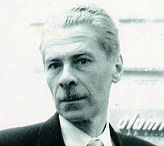 lexander Imich was born in Częstochowa on 4th February 1903 into a secular family. His father, who owned a decorating business, installed an airstrip for early aviators. “At the time, flying was a demonstration,” he recalls. “It attracted people for the show.” He called “the aeroplane” the greatest invention of his lifetime. He also remembers Częstochowa’s first automobiles.
He sought to become a captain in the Polish Navy, but as a Jew was told to forget it. “I decided to become a zoologist and travel to exotic countries in Africa,” Alexander recalled. But blocked from advancement, he switched to chemistry, earning a doctorate at Jagiellonian University in Kraków.
On 4th May 1921, he sat for his written matriculation examinations at the Sienkiewicz school, and then, on 5th June 1921 sat for his oral examinations.
In the early 1930’s, Alexander Imich grew fascinated with a Polish medium who was known as “Matylda S.”, a doctor’s widow gaining renown for séances that reportedly called up the dead. He participated in numerous inexplicable encounters that he detailed in a German scholarly journal in 1932 and recounted in an anthology he edited, “Incredible Tales of the Paranormal”, published by Bramble Books in 1995 (at the age of 95!!).
He keeps a box of forks and spoons twisted in macropsychokinesis experiments. “I watched ordinary people doing that,” he said, although he himself was unable to duplicate it.
He married a childhood sweetheart who, a few years later, left him for another man. He then married her friend, Wela. When the Nazis overran Poland in 1939, they fled east to Soviet-occupied Białystok. Refusing to accept Soviet nationality, they were shipped off to a labour camp.
With Russia reeling under German attack, they were freed and moved to Samarkand, in what is now Uzbekistan, and then back to Poland. There they found that many family members had died in the Holocaust. In 1951, they immigrated to Waterbury, Connecticut.
Wela Imich, a painter and psychotherapist, opened a practice in Manhattan. After she died in 1986, Alexander moved into her suite in a pre-War apartment hotel in Manhattan. Eight years later, it was turned into a luxury seniors residence and he was “grandfathered” in. His savings vanished in dubious investments and The New York Times Neediest Cases campaign came to his aid in 2007.
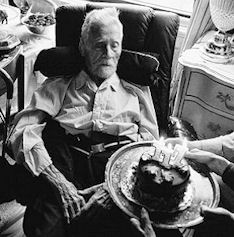 He and his wife never had children. (His closest relative is an 84-year-old nephew.)
So what are his secrets of longevity? Did his many hardships prolong his life? “It’s hard to say.” He credited “good genes” and athletics. “I was a gymnast,” he said. “Good runner, a good springer. Good javelin, and I was a good swimmer.” He used to smoke, but gave it up long ago. Alcohol? Never, he said.
He always ate sparingly, inspired by Eastern mystics who disdain food. “There are some people in India who do not eat,” he said admiringly. Now, his home-care aides said that he fancies matzo balls, gefilte fish, chicken noodle soup, Ritz crackers, scrambled eggs, chocolate and ice cream.
(Alexander Imich passed away on Sunday 8th June 2014. He held the title of the world’s oldest man, albeit sadly, for only a short time.)
Sources:
The New York Times
and
Częstochowa biuletyn informacji publicznej.
The Finkelstein Family
The Finkelstein Family
nee Dziubas
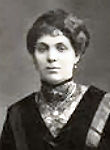
The Dziubas family was very orthodox, Gere Hassidim, and, on ul Nadrzeczna 36-38, they built the biggest soap factory in Poland and Russia.
In 1895, Majtla Dziubas married Abraham Hanoch Finkelstein, who was born in Sosnowiec.
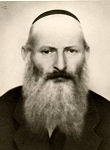
As well as being a Jewish scholar, Abraham was a chemist and worked in his father-in-law’s soap factory, while studying Jewish texts “all day long”.
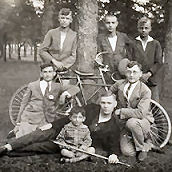 Between 1896 and 1913, they had eleven children, eight sons and three daughters. Each of them eventually turned away from religion and became a Socialist-Zionist – several were members of Hashomer Hatsair.
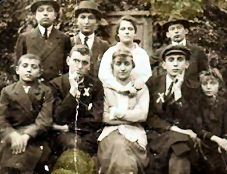 Living by the Warta River, their home was vibrant with a passion for chemistry, music, and tikkun olam. Majtla was such a good mother that each child had the feeling he/she was her favourite.
The older son, Motel, became a journalist. Because of the numerus clausus, Moshe, Victor and, later, my father Luzer went to France to study.
In 1933, Abraham died of a heart attack.
R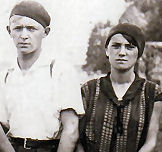 egina survived working in Hasag, Cesia and Włodek worked in Germany as Aryan Poles, Luzer> fought with the partisans in Belarus, Perec escaped to Russia.
Motel was tortured and murdered in Treblinka. Sala died of typhus in Częstochowa.
My grandmother, Majtla was taken to Treblinka in September 1942. Her grandchildren, who never knew her, are dispersed around the world in Israel, France and the United States.
Sylvie Finkelstein
– granddaughter of
Abraham Hanoch and
Majtla (nee Dziubas) Finkelstein
Felix Beatus z"l
Felix Beatus
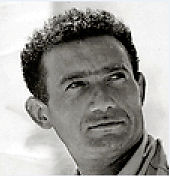 Felix Beatus was born in 1917 into an assimilated family in Kalisz. Around 1931, they moved to Częstochowa, where his family ran a paper-bag manufacturing business on ul.Garibaldiego. When War broke out in 1939, with his wife Francesca, he fled with the Polish army retreating into Russia-Ukraine, where he found work near the city of Sitri as a driver. Francesca worked as a nurse.
In June 1941, when Germany invaded Russia, Felix’s truck was stopped at a road block. That same night, he was drafted into the Red Army as a truck driver. Felix said to the Russian commander, “Either I’ll be a good soldier or no soldier at all. But you have to let me inform my wife that I’ve been drafted”. The Commander agreed and sent him, with a guard, to tell his wife. The next time he saw his wife was nearly four years later, after the War.
As a driver, Felix’s technical talent was already evident. There were no spare parts but many scrap vehicles were littered along the roads. At the age of 28, he was sent to the Ukrainian front, where he was wounded. When he recovered, he was sent to become a tank soldier in the Polish Army which had been established by the Soviets.
His commanders wanted Felix to become a Politruk (a army political officer), but he refused saying that he did not wish to become a “Politruk Jew among Polish soldiers”. However, his commanders insisted and threw him into prison, Eventually he was released and dispatched to a T-34 tank commanders course.
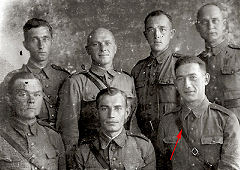
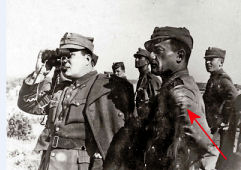
At the end of the course, in October 1943, Felix was sent to the fight near Warsaw with General Herling. The Poles sent him to an armoured officer’s course in Russia and then on to an advanced armoured reconnaissance course.
In July 1944, Felix’s Polish brigade arrived in Lublin and he was among those who liberated the Majdanek death camp. After Lublin, the great battle to retake Warsaw from the Germans began. Felix was in the intelligence unit’s patrol division which formed the bridgehead on the Wisła River, enabling the first tanks to cross to the other side.
The Warsaw Uprising broke out. The Polish military commanders wanted to join the rebels and to participate in the liberation of Warsaw, but the Russians were apparently more interested in the downfall of the Polish Army. The Uprising failed with thousands of casualties.
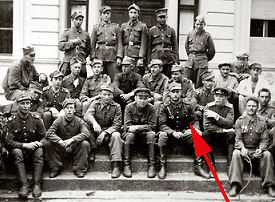 Meanwhile, Felix’s commanders decided to send him to the Molotov Academy in Leningrad where, for half a year, he studied advanced armoured warfare. This was vocational training at the highest-level given to commanders of armoured brigades. Study was based on lessons learned from fighting the war, not yet ended. Each participant learned combat planning and practice of a full armoured brigade. Field training sessions were held at brigade level with the help of Finland.
Following this training, Felix returned to the Wisła front where he commanded a Polish Army armoured battalion comprised of Russian soldiers and tanks. In one of the fiercest battles against the Germans, in April 1945, his force was practically destroyed, leaving him with only seven tanks. Russian reinforcements of Stalin tanks with 122mm guns saved the rest of his unit. In May 1945, he completed his service on the border of the Czech Republic and Germany.
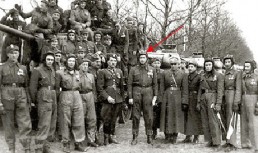
Felix was then called, with his unit, to the city of Stettin, where Germans, Russians and Poles, who returned from captivity, were fighting each other. He received an order from Moscow to clear the city of German residents, and turn it into purely Polish town before the Potsdam Conference (July 1945, the division of spheres of influence in Europe following the fall of Germany). Stettin then became Szczecin.
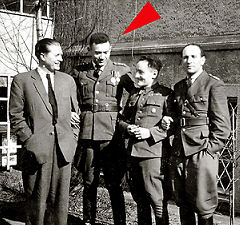
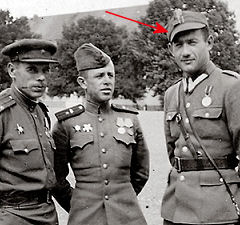
Within six weeks, Felix had managed to transfer a quarter of a million German inhabitants of Stettin and had become Military Governor of the city. It was here that Felix was first exposed to “Irgun Ha’Bricha”. Under pressure from his wife, he met with members of the Aliyah Bet organisation and helped them to illegally smuggle Holocaust survivors to Palestine.
On 16 April 1946 the Polish Government decided to hold a victory parade in Szczecin and Felix was assigned the task of organising it. Among the guests he invited was a Jewish youth group undergoing agricultural training prior to immigration to Palestine. While heading the parade’s armoured column, he could see Jewish youth marching with both the Polish flag and the blue and white flag. He also saw how they were despised by thousands of the Polish Scouts yelling “Jews to Palestine”. It was apparently then that he came to the decision to immigrate to Israel.
 On 27th May 1947, Felix arrived in Palestine with his family. While he was fluent in Polish, Russian and German, he knew not one word of Hebrew. Maccabi Motzri (a senior Haganah and Palmach officer at the time) met him and took him to meet with Yitzhak Sadeh, Yigal Allon and Dan Lehner in a Tel Aviv Cafe. With Yitzhak Sadeh, he spoke Russian, with Dan Lehner, he spoke German. However, Yigal tried to speak to him in Yiddish, a language which Felix did not understand. “How come you are Jewish and don’t understand Yiddish?”, Allon asked him.
With an interpreter, Felix was sent first to the Galilee, where Yitzhak Sadeh had asked him to organise the planning of its defence. In Kibbutz Ayelet Hashachar, he met Molah Cohen, commander of the Palmach Third Battalion, who asked him “How long have you been in the country? You seem so familiar with the area!” According to Dan Lehner, “Felix has been here only a few days and knows all the places just from studying the maps”.
Until March 1948, Felix was busy creating an armoured warfare training facility. He had brought with him a great deal of training literature and translated it in the Sarona training camp (now the Ministry of Defence centre in Tel Aviv).
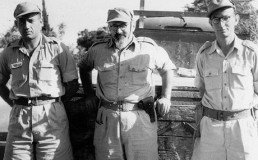
When the fighting began on the roads, he persuaded Yitzhak Sadeh to stop using armoured “sandwich” vehicles with arrow slits, since they were like death traps with limited fire and observation possibilities. Instead, he developed a protected vehicle based on a Dodge truck with a welded steel bottom plate and top turret of steel with the possibility of easy swing and machine gun openings.
Yitzhak Sadeh then called Felix and said to him, “We have some tanks!”
According to Felix, “We came to a large warehouse at the port of Tel Aviv. There were ten Hotchkiss H-35 tanks, each one with a technical problem. This was a French tank, developed after World War I, with a short 37mm cannon. The next day we went to an orchard in Bnei Brak where there were some half-tracks.
“That’s it”, said Yitzhak Sadeh. “Now we can form an armoured battalion.”
“That’s not enough”, replied Felix. “We still need soldiers, mechanics, communications, ammunition and supplies”.
“Look”, said Yitzhak Sadeh. “We have a Commander, that’s you, and we have tanks. As far as the rest is concerned, we’ll manage!”
Felix recalled that “during the first two weeks of April, new immigrants, who previously served in the armoured corps, started arriving from Czechoslovakia and Russia. They began to get organized in Tel-Levinsky, amidst a jumble of languages. I decided to set up three companies: the Slavs would have the Hotchkiss, the Anglo-Saxons would have the Cromwell tanks stolen from the English and the two Sherman tanks assembled from different spare parts, and an Etzel squadron under the command of the Jacob Banai would get the half-tracks”.
With the 8th Brigade, commanded by Yitzhak Sadeh, the first armoured battalion of the IDF (the 82nd) under the command of Felix Beatus, was established in May 1948 and it’s first battle was in Operation Dani, the conquest of Ramle-Lod, the nearby airport and the villages and roads in the area.